Quantum Computing Made Clear: Qubits, Circuits, Algorithms, and Practical Uses
Introduction
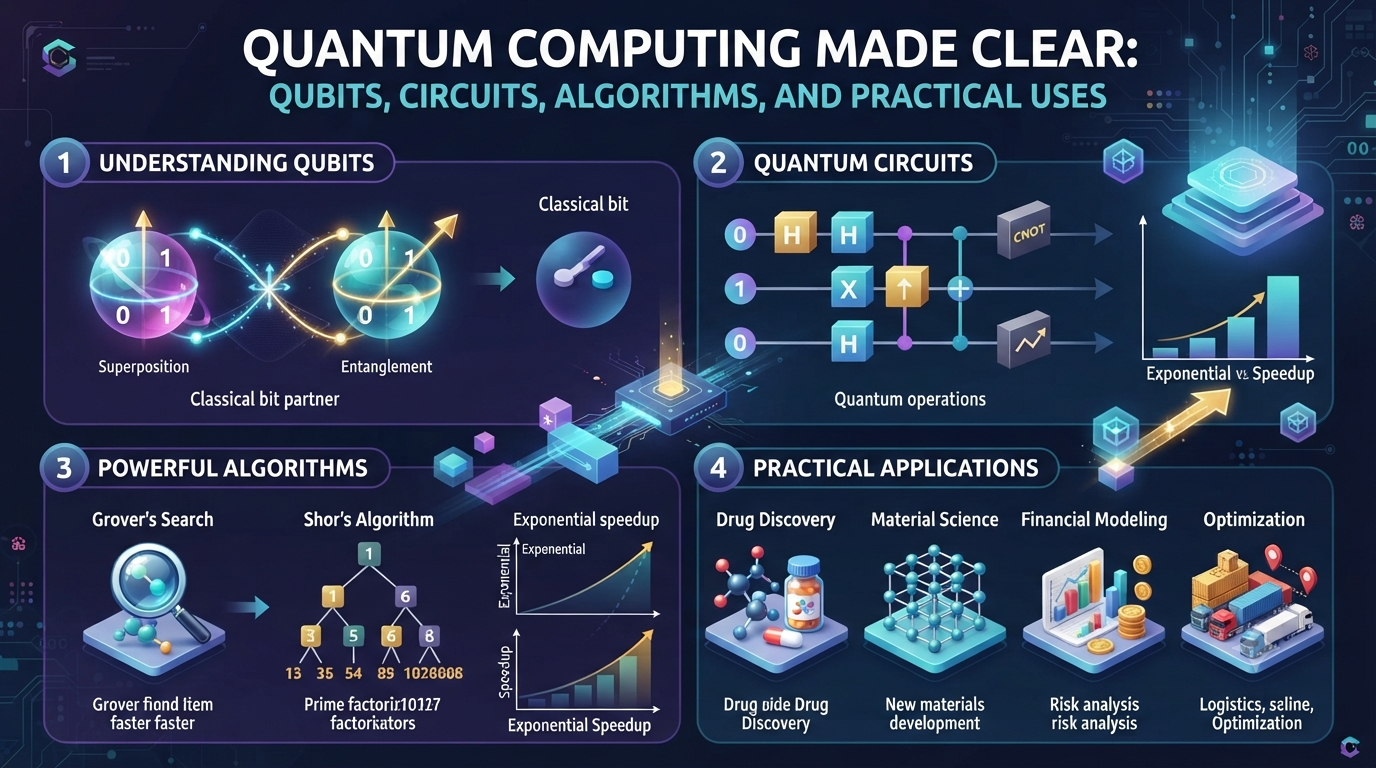
Quantum computing is a new way to process information. It uses ideas from quantum physics to solve certain problems. Traditional computers use bits to store and process data. Quantum computers use special units called qubits. These units behave in ways that ordinary bits cannot. This difference may help researchers study complex molecules, materials, and other difficult systems. However, quantum computers are not faster for every task. They also cannot replace everyday computers. Their value depends on the problem, the algorithm, and the quality of the machine. This article explains the main ideas in clear language. It covers qubits, quantum gates, circuits, algorithms, security, and practical uses. It also gives beginners a simple path to explore this field through resources such as QuantumUting.
What Does Quantum Computing Mean?
Quantum computing is a type of computing based on quantum mechanics. Quantum mechanics describes how very small things behave. These include atoms, electrons, and light particles. A quantum computer uses these rules to process information.
A normal computer stores information as bits. Each bit has one value: zero or one. A quantum computer uses qubits. A qubit can hold a combination of possible states before measurement. This property is called superposition.
Quantum computers also use another property called entanglement. It links the states of different qubits. These links can help a quantum algorithm process information in special ways.
Quantum computing does not mean that a machine tries every answer at once. A quantum computer must still follow a carefully designed process. Its operations change the possible outcomes. Measurement then gives a result.
The main goal is to solve selected problems more effectively. Some tasks may benefit from quantum methods. Other tasks remain better suited to normal computers. This is why researchers study each use case carefully.
Why This Matters for Learners and Professionals
Quantum computing may affect several areas of science and technology. It can offer new ways to study problems that are hard to model. It also creates new questions about digital security.
Students can learn the basic ideas behind quantum information. Developers can explore how quantum circuits work. Researchers can study methods for simulating molecules and materials. Security professionals can prepare for changes in encryption.
A basic understanding also helps people judge technology claims. News reports may describe quantum computers as machines that can solve every problem quickly. That view is misleading. Quantum computers have limits, and useful results depend on the task.
Learning the subject can build skills in physics, mathematics, and computing. It also helps people understand the difference between proven results and future possibilities.
Quantum Computing for Beginners
Quantum computing for beginners starts with a few simple ideas. You do not need to master advanced physics first. Begin with bits, qubits, and the basic rules of quantum behavior.
A classical bit stores either zero or one. A qubit can exist in a combination of zero and one. This combination is called superposition. It does not mean that a person can read both values at once.
Think about a spinning coin. Before it stops, its final result is not yet known. A qubit is more complex than a spinning coin, but the example can help explain uncertainty.
Quantum computers use controlled operations to change qubit states. These operations are called gates. A series of gates forms a circuit. The circuit is designed to solve a particular problem.
When a quantum computer measures a qubit, it produces a classical result. The result may be zero or one. A single measurement does not show every part of the earlier quantum state.
Beginners should also understand that quantum computers need special hardware. Many systems use very cold environments. Others use different physical methods. Each approach has its own strengths and limits.
What Is a Qubit?
A qubit is the basic unit of quantum information. The word combines “quantum” and “bit.” It plays a role similar to the bit in a classical computer.
A classical bit has one clear value. It is either zero or one. A qubit can exist in a superposition of these two basic states. The state includes information about the chance of each measurement result.
The question what is a qubit becomes easier when you separate its state from its measured result. Before measurement, a qubit may have a mix of possible outcomes. When measured, it gives one result.
Superposition
Superposition allows a qubit to hold a combination of states. The exact combination matters. It affects the chance of getting zero or one during measurement.
This property helps quantum algorithms create useful patterns. The algorithm uses gates to change those patterns. It aims to increase the chance of useful answers.
Entanglement
Entanglement is a connection between quantum systems. When two qubits become entangled, their measurement results can be linked. The connection remains even when the qubits are far apart.
Entanglement does not allow instant messages across space. It also does not mean that one qubit sends information to another faster than light. It is a special relationship between quantum states.
Measurement
Measurement turns quantum information into a classical result. A qubit gives one outcome when measured. The act of measurement also changes the state.
This is important because a quantum computer cannot simply display every possible state. It must use an algorithm that guides the measurement toward useful results.
Quantum Gates Explained
Quantum gates are operations that change qubit states. They are the basic building blocks of quantum circuits. A gate can change a qubit or connect the actions of several qubits.
Quantum gates differ from common logic gates. Many quantum gates are reversible. They also work with superposition and phase information.
Understanding quantum gates explained helps learners see how a circuit performs a calculation. Each gate has a specific role. A sequence of gates creates the full process.
Pauli-X Gate
The Pauli-X gate flips a basic qubit state. It changes zero to one and one to zero. This makes it similar to a NOT gate in classical computing.
When applied to a qubit in superposition, it changes the state in a defined way. It does not simply produce a random result.
Hadamard Gate
The Hadamard gate creates an even superposition from a basic zero or one state. This gives the qubit equal chances of producing either result during measurement.
It is useful at the start of many quantum circuits. It helps create the state needed for later operations.
Pauli-Z Gate
The Pauli-Z gate changes the phase of a qubit state. Phase is a part of quantum information. It can affect how states combine later in a circuit.
The gate may not change the direct measurement chances on its own. Yet its effect can become important after other gates.
CNOT Gate
The CNOT gate works with two qubits. It flips the target qubit when the control qubit has the required value. This gate can help create entanglement.
These examples make quantum gates explained easier to understand. Real circuits may use many more gates. Each circuit uses operations that match its purpose.
A Quantum Circuits Tutorial in Words
A quantum circuit is a sequence of operations applied to qubits. It tells a quantum computer which gates to use and in what order. A quantum circuits tutorial usually begins with three main steps: prepare, operate, and measure.
Step 1: Prepare the Qubits
The computer first creates the required starting state. Some circuits begin with qubits in a basic state. Others need a prepared state for a specific task.
Step 2: Apply Quantum Gates
The circuit then applies gates to the qubits. Each gate changes the quantum state. The order matters because one operation can affect the result of another.
Some circuits use gates on single qubits. Others use gates that act on two or more qubits. These operations can create superposition and entanglement.
Step 3: Measure the Qubits
The computer measures the qubits after the circuit runs. Each measurement gives a classical result. A circuit often runs many times to collect a useful set of results.
Step 4: Review the Results
A classical computer can count and analyze the outcomes. Researchers compare the results with the expected behavior. They may adjust the circuit if the output is not useful.
A quantum circuits tutorial can also use a simulator. A simulator runs a model of a quantum circuit on a classical computer. It helps learners test basic ideas before using quantum hardware.
Tools such as Qiskit provide ways to build and study circuits. Beginners can explore gates, measurements, and circuit behavior without needing to own a quantum computer.
Quantum Computing Algorithms Explained
An algorithm is a clear set of steps for solving a problem. A quantum algorithm uses quantum states and gates to process information. It must be designed for a problem that can benefit from quantum methods.
Quantum computing algorithms explained should include both the possible benefits and the limits. A quantum algorithm does not make every calculation faster. Its performance depends on the problem and the classical method used for comparison.
Quantum Search
Quantum search methods can help locate a marked item in an unstructured search space. Grover's algorithm is a well-known example. It can reduce the number of search steps compared with a basic classical search.
This does not mean that every database search becomes faster. The data must be prepared in a suitable way. The cost of loading and reading data also matters.
Quantum Factoring
Factoring means breaking a number into smaller factors. For example, a number may be written as a product of prime numbers. Factoring large numbers is important in some areas of digital security.
Shor's algorithm is a quantum method for factoring integers. It shows why large, reliable quantum computers could affect some public-key encryption systems.
Quantum Simulation
Quantum computers may help model quantum systems. These include molecules, atoms, and materials. Such systems can be difficult to describe with ordinary computers as their complexity grows.
Researchers are studying whether quantum hardware can improve these simulations. Many practical uses remain under development.
Why Algorithms Need Careful Testing
A useful algorithm needs more than an interesting idea. It must run on hardware with enough reliable qubits. It must also manage errors and produce results that matter.
Quantum computing algorithms explained in simple terms should always include these limits. A theoretical advantage does not prove a practical advantage on today's machines.
Shor's Algorithm Explained
Shor's algorithm is a quantum algorithm for factoring large integers. It is important because some public-key security systems depend on the difficulty of factoring large numbers.
The method uses quantum operations to find a repeating pattern. A classical process then uses that information to help find factors. This approach can be much more efficient than known classical factoring methods for sufficiently large inputs.
Shor's algorithm explained in simple terms shows both the promise and the risk of quantum computing. A large, fault-tolerant quantum computer could threaten some widely used public-key systems.
However, today's quantum computers do not have the scale and error protection needed to break common large encryption keys with this method. Building such machines remains a major technical challenge.
Shor's algorithm does not break every form of encryption. It targets mathematical problems used by certain public-key systems. Other security methods need separate analysis.
The topic matters to security teams because data may need protection for many years. Organizations should understand which systems rely on vulnerable public-key methods. They should also follow trusted security guidance when planning changes.
Post-Quantum Cryptography Explained
Post-quantum cryptography is the study of encryption methods designed to resist attacks from both classical and future quantum computers. These methods are important because some current public-key systems may be at risk from large, fault-tolerant quantum machines.
Post-quantum cryptography explained in simple terms means preparing digital security for a different computing future. It does not require a quantum computer to run. These methods can work on ordinary computers and networks.
Why Security Needs to Prepare
Many digital services use public-key cryptography. It helps protect online communication, software updates, and digital identity. Some systems rely on mathematical problems that a large quantum computer could solve more efficiently.
Data that must stay private for a long time may face a special risk. An attacker could collect encrypted data today and try to decrypt it later. This is one reason security teams are reviewing their systems.
How Post-Quantum Methods Help
Post-quantum methods use mathematical problems that are believed to resist known quantum attacks. Security experts study these methods and test their safety.
Standards organizations are working on approved methods. Businesses and public agencies need to review their systems before making changes. The process includes software, hardware, networks, and stored data.
Post-quantum cryptography explained should not be confused with quantum cryptography. Quantum cryptography uses quantum physics as part of a communication method. Post-quantum cryptography uses mathematical methods that run on normal computing devices.
Real-World Applications of Quantum Computing
The real-world applications of quantum computing are still developing. Most current work takes place in research and testing. Scientists are exploring areas where quantum systems may offer useful results.
Chemistry and Drug Research
Molecules follow the rules of quantum physics. Quantum computers may help researchers model chemical behavior. Better models could support studies of reactions and possible drug compounds.
This does not mean quantum computers can create new medicines on their own. Medical research still needs laboratory testing, safety checks, and clinical studies.
Materials Science
Researchers study materials to understand their properties. Quantum simulation may help explore how atoms and electrons behave inside materials.
This work could support research into batteries, catalysts, and other useful materials. Practical benefits still need to be tested.
Optimization
Optimization means finding a good solution under given limits. Examples include planning delivery routes or managing resources.
Some quantum methods may help with certain optimization problems. However, researchers must compare them with strong classical methods. A quantum approach is not automatically better.
Finance
Financial organizations study risk, pricing, and portfolio choices. Quantum computing may offer new ways to explore selected mathematical models.
These uses remain experimental. Businesses should not assume that quantum systems already provide better financial decisions.
Artificial Intelligence
Researchers are exploring links between quantum computing and machine learning. This field is often called quantum machine learning.
It may offer new methods for selected tasks. Yet practical benefits remain uncertain. Normal computers continue to support most AI systems.
Cybersecurity
Quantum computing affects security because of its possible impact on some public-key systems. At the same time, post-quantum cryptography can help protect digital information.
The real-world applications of quantum computing include both new research opportunities and security challenges. Each area needs careful testing before broad use.
How to Learn Quantum Computing
The best way to start is to build a strong base. You do not need to learn every topic at once. Focus on simple concepts and practice them in order.
Learn Basic Mathematics
Start with basic algebra, probability, and vectors. These ideas help explain quantum states and measurement results. Linear algebra becomes more useful as you study deeper topics.
You do not need advanced mathematics on your first day. Learn each idea when it becomes useful.
Understand Basic Physics
Learn the main ideas of quantum mechanics. Focus on superposition, measurement, and entanglement. Try to understand what each term means before studying complex formulas.
Study Programming
A basic understanding of programming can help you explore quantum circuits. Python is a useful language to know. You can use it with quantum software tools and simulators.
Practice with Circuits
Start with simple circuits. Try a single qubit and a few basic gates. Then study how measurement changes the output.
A quantum circuits tutorial can help you understand the order of operations. Build small examples and compare their results with your expectations.
Explore Learning Resources
QuantumUting.com is an educational technology website focused on quantum computing. Its theme is “Decoding the Quantum Future.” It publishes tutorials, beginner guides, technical explanations, and educational articles.
Readers can use such material to explore key ideas at their own pace. When studying a new topic, compare explanations with trusted technical sources. This helps prevent confusion and supports steady progress.
Build Knowledge Step by Step
A practical learning path may look like this:
- Understand classical bits and basic computing.
- Learn what a qubit is and how measurement works.
- Study superposition and entanglement.
- Explore common quantum gates.
- Build simple circuits with a simulator.
- Read about quantum algorithms.
- Learn about encryption and post-quantum security.
- Review current research and its limits.
How to learn quantum computing depends on your starting point. A student may focus on mathematics and physics. A developer may begin with programming and circuit tools. A professional may focus on a specific research or security area.
Common Mistakes Learners Make
Quantum computing can seem confusing at first. Some common mistakes make it harder to understand. Avoid these points while studying the subject.
- Thinking a qubit is simply two bits: A qubit is a quantum state, not two ordinary bits stored together.
- Assuming superposition reveals every answer: Measurement gives one result, not a full list of possible outcomes.
- Treating entanglement as instant communication: Entanglement links quantum states but cannot send messages faster than light.
- Believing quantum computers are always faster: They may help with selected problems, not every computing task.
- Confusing gates with algorithms: Gates are operations. Algorithms use operations in a planned sequence.
- Ignoring measurement: Measurement changes the quantum state and produces a classical result.
- Expecting perfect hardware: Current quantum devices face noise and errors.
- Assuming all encryption is at risk: Shor's algorithm targets certain mathematical problems used in some public-key systems.
- Confusing post-quantum and quantum cryptography: One uses resistant mathematical methods on normal computers. The other uses quantum effects.
- Trusting every future claim: Research results need evidence, testing, and clear limits.
A Simple Example
Imagine a student wants to understand how a quantum circuit works. The student opens a simulator and creates one qubit. The starting state is zero.
The student applies a Hadamard gate. This creates an even superposition. The student then measures the qubit. The result is either zero or one.
The student repeats the circuit many times. The results show a pattern. Around half may be zero, and around half may be one. Small differences can appear because measurements are probabilistic.
Next, the student tries a Pauli-X gate. This flips the basic zero state to one. The student measures the qubit again and sees the changed result.
This example shows how gates affect qubits. It also shows why measurement matters. A learner can explore more circuits through a simulator and educational material from QuantumUting.com.
How QuantumUting Can Help
QuantumUting.com is an educational technology website with the theme “Decoding the Quantum Future.” It shares content for readers who want to understand quantum computing and related ideas.
The website publishes beginner guides and technical explanations. These can help readers explore subjects such as qubits, quantum circuits, gates, algorithms, and quantum security.
A learner can use educational articles to build a basic understanding. Developers and technology professionals can explore more technical topics. Readers can also use the material as a starting point for further study.
QuantumUting.com is useful as a reading resource. It should be used alongside textbooks, research papers, and trusted technical references. This approach helps readers compare explanations and develop a balanced view.
The site can support a learning journey from basic terms to more advanced topics. Readers should still check important technical claims against reliable sources. Quantum computing continues to develop, so careful reading remains important.
FAQs
1. What should I study first for quantum computing for beginners?
Start with basic computing, probability, and simple physics. Learn the difference between bits and qubits. Then study superposition, entanglement, and measurement. You can explore simple circuits after that. A step-by-step approach makes quantum computing for beginners easier to understand.
2. What is a qubit in simple terms?
A qubit is the basic unit of quantum information. Unlike a normal bit, it can exist in a combination of zero and one states. Measurement gives one result. Learning what is a qubit helps explain why quantum computers use different rules from classical machines.
3. Is quantum computing vs classical computing mainly about speed?
No. The main difference is how each system stores and processes information. Classical computers use bits, while quantum computers use qubits. Quantum systems may help with selected tasks. Quantum computing vs classical computing should be judged by the problem, not by speed alone.
4. What can a beginner learn from a quantum circuits tutorial?
A quantum circuits tutorial explains how qubits move through a series of gates. It shows how circuits prepare states, apply operations, and measure results. Beginners can use simulators to test simple circuits. This practice helps connect theory with actual circuit behavior.
5. Why are quantum gates explained as circuit building blocks?
Quantum gates change qubit states. A circuit combines these operations to perform a task. Pauli-X, Hadamard, Pauli-Z, and CNOT gates have different roles. Quantum gates explained through small examples can help learners understand how a circuit produces its final measurement results.
6. What topics are covered in quantum computing algorithms explained?
The topic includes methods such as quantum search, factoring, and quantum simulation. Each algorithm is designed for a certain type of problem. Quantum computing algorithms explained should also cover hardware limits, measurement, and comparisons with strong classical methods.
7. Can Shor's algorithm explained help people understand encryption risks?
Yes. Shor's algorithm can factor large integers efficiently on a sufficiently capable quantum computer. This matters because some public-key systems rely on factoring being difficult. Shor's algorithm explained also needs an important limit: current quantum computers cannot break common large keys with it.
8. Does post-quantum cryptography explained mean using a quantum computer?
No. Post-quantum cryptography uses mathematical methods designed to resist known classical and quantum attacks. It runs on ordinary computers. Post-quantum cryptography explained is important for organizations that protect sensitive data and need to prepare their security systems.
9. Which real-world applications of quantum computing are being studied?
Researchers study chemistry, materials, optimization, finance, and security. These areas may benefit from new ways to model difficult problems. Most real-world applications of quantum computing remain under research. Each proposed use needs testing before anyone can claim a clear practical advantage.
10. How to learn quantum computing without advanced experience?
Begin with basic mathematics, programming, and simple quantum ideas. Use simulators to practice small circuits. Read beginner guides and review reliable technical material. How to learn quantum computing depends on your goals, but steady practice and careful study provide a strong start.
Final Thoughts
Quantum computing offers a different way to process information. Its main ideas include qubits, superposition, entanglement, gates, and circuits. These concepts help explain how quantum algorithms work. Yet quantum computers still face major hardware and error challenges. They are not replacements for classical computers. Their value depends on the problems they can solve well. Beginners should focus on clear concepts and simple practice. Professionals should also follow changes in quantum security and research. Always check technical claims against trusted sources. QuantumUting.com can provide educational articles for further reading as you explore the field.