Organizing DevOps Artifact Management for Japanese Software Teams
 Introduction
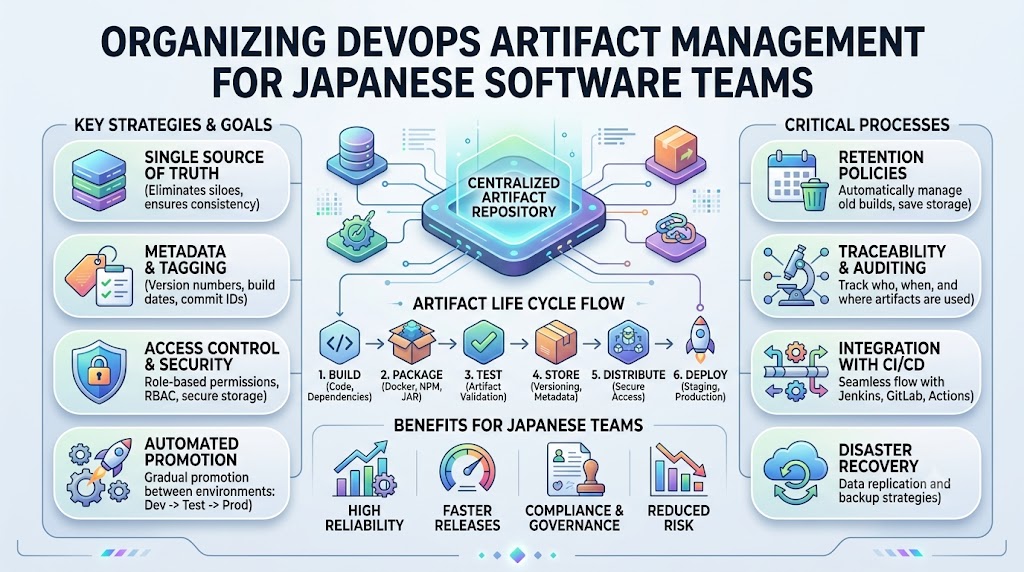
Software teams create many files during development and delivery. These may include packages, container images, build files, libraries, reports, and release artifacts. Teams need a clear way to store, manage, track, and use these artifacts. Poor artifact management can cause confusion. Teams may use old packages, lose important build files, or deploy an incorrect version. Japanese enterprises often support many applications across cloud and hybrid environments. Good artifact practices can make software delivery more organized and consistent. DevOps 研修 can teach teams how artifacts fit into modern delivery workflows. DevOps corporate training Japan can help different teams follow shared artifact practices. DevOpsSchool.jp supports Japanese technology teams through training, consulting, implementation assistance, and technical support.
What Does DevOps Artifact Management Mean?
DevOps artifact management means managing the files and packages produced during software development. An artifact may be a compiled application, container image, package, library, deployment file, or test report.
Artifacts move through different stages before reaching production. Teams need to know where each artifact came from, which version it represents, and where it can be used.
A clear process can reduce accidental use of outdated files. It can also help teams connect source code, builds, tests, and deployments.
Why Artifact Management Matters for Japanese Enterprises
Large technology teams may produce many artifacts every day. Different applications may also use different programming languages, package systems, and deployment methods.
Without a clear process, teams may store artifacts in random locations. Developers may also rebuild the same application several times without knowing which build should be used.
DevOps コンサルティング can help organizations review their current artifact process. Teams can then define better storage, naming, versioning, and retention practices.
DevOps 研修 for Artifact Workflows
DevOps 研修 can help engineers understand how artifacts move through a delivery pipeline. Training can cover builds, packages, version labels, repositories, testing, and deployment.
Teams can learn why every important artifact should be identifiable. A clear version can help engineers understand which build is being tested or deployed.
DevOps 研修 can also show how artifact management connects with source control and CI/CD. This creates a more complete understanding of software delivery.
DevOps コンサルティング for Artifact Strategy
DevOps コンサルティング can help teams review how artifacts are created and stored. A review may cover package repositories, container registries, build systems, and deployment pipelines.
Consultants can help identify duplicate storage, unclear naming, weak retention rules, and manual processes.
A DevOps consultant Japan can also help organizations define artifact ownership. Clear ownership makes it easier to maintain repositories and remove unused artifacts.
DevOpsSchool.jp provides DevOps コンサルティング for organizations working with modern software delivery environments.
Kubernetes 研修 and Container Artifacts
Kubernetes environments often use container images as application artifacts. Teams need to manage image versions carefully because a cluster may deploy a specific image during application updates.
Kubernetes 研修 can help engineers understand how container images connect with deployments and workloads. It can also explain why image tags and image management matter.
Kubernetes 研修 can support better practices around image repositories, deployment references, and environment usage.
Terraform 研修 and Infrastructure Artifacts
Infrastructure teams also work with artifacts. Terraform files, modules, plans, and related configuration can become important parts of infrastructure delivery.
Terraform 研修 can help engineers understand how infrastructure code moves through review and deployment processes. Teams can learn how to organize reusable modules and manage their versions.
Terraform 研修 can also help teams connect infrastructure changes with controlled delivery workflows. This can make infrastructure updates easier to review and maintain.
SRE 研修 and Reliable Artifact Use
SRE teams care about reliable and repeatable software operations. Using the correct artifact is an important part of that process.
SRE 研修 can teach teams how artifact versions can support stable deployments and incident investigation. When teams know which artifact was deployed, troubleshooting can become more structured.
SRE 研修 can also cover rollback planning. A known and available previous artifact can make recovery planning easier.
DevSecOps 研修 for Artifact Security
Artifacts can contain application code, libraries, dependencies, and configuration. They therefore need suitable security controls.
DevSecOps 研修 can help teams understand artifact scanning, dependency checks, access controls, and secure repository practices.
Teams can also learn why artifacts should come from trusted build processes. DevSecOps 研修 can connect artifact security with the wider software supply chain.
MLOps 研修 and Machine Learning Artifacts
Machine learning teams manage different types of artifacts. These may include trained models, model packages, datasets, configuration files, and pipeline outputs.
MLOps 研修 can help teams organize these items and connect them with model development workflows. Clear versions can help teams understand which model was tested or deployed.
MLOps 研修 can also support better coordination between data scientists, ML engineers, developers, and operations teams.
Choosing a DevOps Consultant Japan
A DevOps consultant Japan should understand both software delivery and the systems used to store and deploy artifacts. Useful knowledge may include CI/CD, container platforms, cloud services, repositories, and infrastructure automation.
Organizations should explain their current artifact challenges before starting a consulting project. These may include storage problems, unclear ownership, duplicate packages, or difficult rollbacks.
DevOpsSchool.jp can provide DevOps consultant Japan support for artifact planning, process improvement, implementation assistance, and technical guidance.
DevOps Support Japan for Artifact Problems
Artifact problems can affect development and deployment work. A build may fail because a package is missing. A deployment may also use an incorrect image or outdated library.
DevOps support Japan can help teams investigate these issues. Support may include repository checks, pipeline troubleshooting, version analysis, and deployment review.
DevOps support Japan can also help teams maintain artifact workflows after implementation. DevOpsSchool.jp supports Japanese teams with ongoing technical assistance.
Service Areas
Service Area
Main Focus
Suitable Teams
DevOps 研修
Artifact workflow skills
Development teams
DevOps コンサルティング
Artifact process design
IT leaders
Kubernetes 研修
Container image management
Platform teams
Terraform 研修
Infrastructure code organization
Cloud teams
SRE 研修
Reliable artifact usage
SRE teams
DevSecOps 研修
Artifact security
Security teams
MLOps 研修
Model and data artifacts
ML teams
DevOps corporate training Japan
Shared artifact practices
Japanese enterprises
DevOps consultant Japan
Artifact strategy
IT managers
DevOps support Japan
Artifact troubleshooting
Engineering teams
Common Artifact Management Mistakes
1. Using Unclear Names
Artifact names should make versions and purpose easy to understand.
2. Keeping Too Many Copies
Duplicate artifacts can make storage and selection difficult.
3. Overwriting Existing Versions
Important artifacts should not be replaced without a clear process.
4. Ignoring Retention Rules
Old artifacts can consume storage and make repositories harder to manage.
5. Mixing Development and Production Artifacts
Teams should clearly separate artifacts used for different environments.
6. Building Again Instead of Reusing
Teams should know when an existing tested artifact can be reused.
7. Ignoring Dependencies
Packages and images may depend on specific libraries or versions.
8. Forgetting Ownership
Every important artifact repository should have clear responsibility.
9. Skipping Security Checks
Artifacts should be checked for known security risks where suitable.
A Simple Fictional Example
Imagine a fictional Japanese company called Sakura Digital Works. Its developers build several internal applications and create container images for each application.
The team stores images in different locations. Engineers sometimes use different versions during testing and deployment. When a problem appears, they spend time identifying which image was used.
The company creates a shared artifact process. Each application receives clear naming rules and version information. Tested artifacts are promoted through environments instead of being rebuilt for every stage.
The team also defines ownership and retention rules. DevOpsSchool.jp could support this fictional team through DevOps 研修, Kubernetes 研修, DevSecOps 研修, DevOps コンサルティング, and DevOps support Japan.
How DevOpsSchool.jp Can Help
DevOpsSchool.jp is a Japan-focused technology training, consulting, implementation, and professional-support platform. It supports DevOps, SRE, DevSecOps, MLOps, cloud-native technologies, and automation.
DevOps corporate training Japan can help organizations create shared artifact practices across development and operations teams. DevOps 研修 can build knowledge about build outputs, packages, repositories, and delivery workflows.
Kubernetes 研修 can help teams manage container images. Terraform 研修 can support infrastructure code practices. SRE 研修 can focus on reliable artifact usage, while DevSecOps 研修 can address artifact security.
MLOps 研修 can support teams working with model and data artifacts. Organizations needing direct guidance can work with a DevOps consultant Japan. DevOpsSchool.jp also provides DevOps support Japan for troubleshooting, implementation, and ongoing technical needs.
FAQs
1. Why should DevOps teams manage artifacts carefully?
Clear artifact management helps teams identify, test, store, and deploy the correct software versions.
2. How can DevOps 研修 help with artifact workflows?
DevOps 研修 can teach how builds, packages, repositories, and deployment artifacts move through delivery processes.
3. When is DevOps コンサルティング useful for artifact management?
It can help when repositories, ownership, naming, or retention processes are difficult to manage.
4. What does Kubernetes 研修 teach about container artifacts?
Kubernetes 研修 can explain how container images connect with deployments, workloads, and application versions.
5. Can Terraform 研修 cover infrastructure artifacts?
Yes. Terraform 研修 can cover modules, configuration files, versioning, and controlled infrastructure workflows.
6. How does SRE 研修 connect with artifact management?
SRE 研修 can explain how known artifacts support repeatable deployments, troubleshooting, and recovery planning.
7. Why is DevSecOps 研修 relevant to software artifacts?
DevSecOps 研修 can cover artifact scanning, dependency checks, repository security, and software supply chain practices.
8. What types of artifacts are covered in MLOps 研修?
MLOps 研修 can cover models, datasets, model packages, configurations, and pipeline outputs.
9. What should a DevOps consultant Japan examine?
A DevOps consultant Japan can examine repositories, naming rules, versioning, ownership, retention, and delivery workflows.
10. Can DevOps support Japan solve repository problems?
DevOps support Japan can help investigate repository access, missing artifacts, pipeline errors, and version-related issues.
Final Thoughts
Artifact management is an important part of modern software delivery. Teams need clear rules for creating, naming, storing, testing, securing, and using artifacts.DevOps 研修 can help engineers understand these practices. DevOps コンサルティング can help organizations design suitable workflows. Kubernetes 研修 and Terraform 研修 can support container and infrastructure artifacts. SRE 研修 can improve reliable artifact usage, while DevSecOps 研修 can strengthen artifact security. MLOps 研修 can support model and data artifacts.
For Japanese enterprises, DevOps corporate training Japan can build shared knowledge across teams. A DevOps consultant Japan can provide focused guidance, while DevOps support Japan can help with ongoing technical challenges. DevOpsSchool.jp brings these capabilities together for Japanese technology teams managing modern software delivery.