Rethinking Data Delivery: Continuous Integration and Pipeline Automation
Introduction
Data engineering teams frequently run into an operational tipping point: as the sheer number of data sources and analytical consumers expands, managing pipelines through manual oversight becomes unsustainable. Small schema changes in upstream databases break downstream reports, untracked modifications lead to inaccurate business metrics, and engineers find themselves spending more time troubleshooting production failures than engineering new platforms.
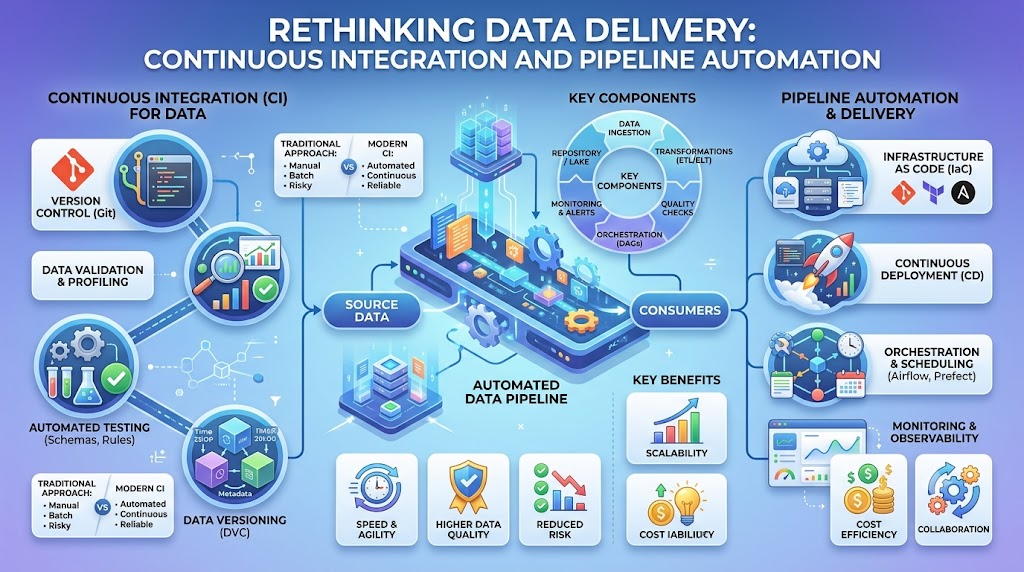
Moving away from fragile, ad-hoc execution requires treating data pipelines as production-grade software applications. By embedding systematic automation—spanning declarative infrastructure, continuous code deployment, automated testing checkpoints, and full-spectrum operational monitoring—data teams build resilient pipelines capable of adapting to shifting organizational demands.
This guide explores the foundational design principles, architectural patterns, and practical execution frameworks needed to construct automated data pipelines within modern DataOps environments.
Redefining Pipeline Automation in Modern Data Architectures
At its core, data pipeline automation is the programmatic orchestration of data ingestion, transformation, validation, and delivery. Rather than depending on human operators to run scripts or monitor schedule execution, an automated pipeline uses software triggers to process records, verify structural integrity, and route outputs correctly across cloud infrastructure.
In legacy environments, batch processing relied heavily on isolated cron schedules. While sufficient for small operational footprints, this approach creates silent failures as system complexity grows. Schedules do not account for late-arriving data, upstream API timeouts, or unannounced database schema updates.
Modern DataOps reimagines automation as an active lifecycle management strategy. Automated workflows respond dynamically to operational events, run assertion checks on data batches, manage compute infrastructure elasticity, and report operational health back to centralized observability hubs.
+-----------------------------------------------------------------------------------+
|                        EVENT-DRIVEN AUTOMATION LIFECYCLE                          |
+-------------------+-------------------+-------------------+-----------------------+
| Upstream Event /  | Dynamic Schema &  | Quality Assertion | Automated Routing     |
| Trigger Detection | Payload Parsing   | & Guardrails      | & Downstream Delivery |
+-------------------+-------------------+-------------------+-----------------------+
        |                     |                   |                     |
        v                     v                   v                     v
+-----------------------------------------------------------------------------------+
|                         CENTRAL OBSERVED RUNTIME CONTROL                          |
+-----------------------------------------------------------------------------------+
Transitioning from manual workflows to event-driven, automated data pipelines yields distinct operational advantages:
- Shortened Lead Time for Changes: Engineers publish transformations securely through automated deployment pathways, reducing deployment cycles from weeks to minutes.
- Deterministic Execution: Eliminating manual operational steps standardizes execution environments, making job outcomes predictable and reproducible.
- Proactive Defect Mitigation: Built-in quality barriers catch missing fields, null variations, and anomalous volumes before bad data pollutes production warehouses.
Integrating DataOps Principles into Automated Engineering
DataOps is not merely a collection of tools; it represents a cultural and structural shift toward continuous, reliable data delivery. Where conventional data engineering focuses on writing the underlying transformation logic, DataOps focuses on how that logic is tested, deployed, monitored, and maintained throughout its production lifecycle.
Key Pillars of an Automated DataOps Architecture
- Declarative Configuration: All pipeline definitions, dependency trees, transformation models, and environment settings are stored as code in version control platforms (such as Git).
- Shift-Left Testing: Validation occurs as early as possible in the development lifecycle. Transformation logic is tested against mock data in continuous integration runs long before touching production databases.
- Automated Continuous Delivery: Pipeline updates transition through staging environments automatically via CI/CD platforms, running automated checks to ensure new commits do not break existing downstream models.
- Isolated Ephemeral Environments: Developers spin up isolated, lightweight environments on demand to validate complex queries against realistic schema definitions without impacting production compute resources.
- Operational Telemetry: Automated pipelines actively emit execution logs, processing metrics, and structural lineage data, providing total operational visibility to platform administrators.
Leveraging specialized educational platforms like TheDataOps.org allows data professionals to master these continuous integration methodologies and align technical implementation with industry standards.
Architectural Layers of an Automated Data Platform
Designing a resilient data platform requires separating pipeline functions into distinct, highly coordinated architectural layers.
+-----------------------------------------------------------------------------------+
|                           DECOUPLED DATA PLATFORM LAYERS                          |
+-----------------------------------------------------------------------------------+
| 1. Ingestion Layer      | Event Streams, CDC Log Readers, API Extractors         |
| 2. Execution Layer      | Distributed Compute, Containerized Jobs (Spark, K8s)    |
| 3. Orchestration Layer  | Event Triggers, DAG Execution Engines (Airflow, Prefect) |
| 4. Validation Layer     | Contract Enforcement, Statistical Profiling           |
| 5. Analytical Layer     | Cloud Warehouses, Feature Stores, Data Lakes           |
+-----------------------------------------------------------------------------------+
1. Programmatic Orchestration
The orchestration layer acts as the control plane. Modern orchestrators define workflows as code (typically in Python or SQL configurations), building directed acyclic graphs (DAGs) that establish logical execution order, handle automatic retry policies, and pass context variables dynamically between execution tasks.
2. Infrastructure provisioning via IaC
Automating processing logic yields limited benefit if underlying cloud databases and compute clusters require manual maintenance. Utilizing Infrastructure as Code (IaC) engines (e.g., Terraform) enables teams to provision storage, set network topologies, and configure compute instances programmatically across cloud providers.
3. Automated Continuous Integration Pipelines
A robust CI workflow executes mandatory checks on every pull request submitted by developers:
- Code linters verify adherence to stylistic and structural standards.
- Unit tests validate custom transformation functions and business logic edge cases.
- Synthetic data generation modules test edge-case payloads against updated code routines.
- Automated deployment scripts deploy verified changes to production once review requirements are met.
Comparing Data Management Disciplines
Distinguishing between adjacent fields helps data organizations define responsibilities and deploy effective platform tooling.
Discipline
Primary Focus
Role in Pipeline Automation
Primary Output / Deliverables
DataOps
Delivery speed, pipeline health, and workflow reliability
Implements CI/CD, automated testing, observability frameworks, and deployment standards
Automated deployment pipelines, data SLAs, operational alert hubs
Data Engineering
Architecture, data modeling, and query optimization
Writes ELT/ETL transformations, designs warehouse schemas, builds ingestion routines
Analytical data models, warehouse tables, optimized ingestion logic
DevOps
System availability, containerization, and networking
Manages underlying Kubernetes clusters, build runners, and cloud infrastructure permissions
Cloud compute platforms, deployment runners, IAM security structures
MLOps
Model lifecycle, feature engineering, and inference
Automates training data pipelines, tracks model drift, and manages feature stores
Retraining triggers, model serving endpoints, feature repositories
Platform Engineering
Developer experience and self-service infrastructure
Constructs internal platforms enabling data teams to provision resources autonomously
Internal developer portals, standardized pipeline templates
Quality Guardrails and Data Observability
Fast automation without inline quality assertions creates systemic business risk. An effective automated platform must continuously validate data integrity throughout processing.
Multi-Stage Quality Guardrails
Testing must be embedded directly into pipeline execution paths:
- Ingestion Threshold Checks: Evaluates incoming files or event streams against pre-configured schema contracts before loading raw data into storage.
- In-Memory Transformation Tests: Asserts primary key uniqueness, checks non-null rules, and verifies expected range boundaries while data undergoes processing.
- Post-Processing Auditing: Compares row counts and summary stats against historical moving averages to detect potential ingestion drops or duplication bugs.
Raw Input ---> [Schema Verification] ---> Processing ---> [Value Constraints] ---> Analytics Storage
                     |                                         |
             Fail: Route to DLQ                         Fail: Quarantine Batch
Modern Data Observability
While logging records whether a software job succeeded or failed, Data Observability focuses on evaluating the state and distribution of the underlying data.
Data observability frameworks track five core attributes:
- Timeliness (Freshness): Identifying when data updates lag behind established business SLAs.
- Volume Consistency: Detecting anomalous spikes or unexpected drops in incoming record counts.
- Schema Stability: Catching structural changes, missing attributes, or altered field types before downstream queries break.
- Value Distribution: Monitoring numerical variations, null-value percentages, and categorical skew over time.
- System Lineage: Mapping end-to-end data dependencies from upstream source databases down to individual reporting dashboards.
Integrating observability platforms ensures that a DataOps Engineer receives real-time notifications about structural drift or missing records before end users encounter reporting errors.
Real-World Automation Scenarios
Scenario 1: Isolated Testing for Analytics Transformations
Analytics engineering teams working on warehouse transformations need a mechanism to test complex SQL changes without risking production reporting environments.
In an automated workflow:
- An analytics engineer modifies a transformation script in a Git feature branch.
- The pull request automatically initiates a deployment action.
- The automated test engine provisions a temporary staging environment in the cloud data warehouse.
- The engine compiles the SQL code, builds temporary views, and executes automated data assertions (verifying unique keys, referential integrity, and expected field logic).
- Upon successful execution, review notifications are dispatched; once merged, the code is deployed to production, and the temporary staging environment is torn down automatically.
[Developer Commits Code] ---> [Pull Request Created]
                                     |
                                     v
                        [Trigger Isolated Staging Run]
                                     |
                                     v
                       [Execute Code & Quality Assertions]
                                     |
                       +-------------+-------------+
                       |                           |
                (Validation Passes)        (Validation Fails)
                       |                           |
                       v                           v
             [Deploy to Production]      [Reject PR & Notify Engineer]
Scenario 2: Handling Schema Drift in Streaming Ingestion
An operational service continually pushes log payloads into an event broker. Developers add new tracking fields to the source application without alerting data platform maintainers.
In a fully automated design:
- The ingestion worker evaluates incoming JSON batches against a schema repository.
- Upon identifying unmapped fields, an automated schema migration module triggers.
- The ingestion tool automatically updates the target staging table structure using non-breaking operations, logging the modification for audit purposes.
- Processing continues without throwing runtime exceptions or halting downstream jobs, and a summary report is sent to the data governance team.
Evaluating the DataOps Tooling Landscape
Constructing an automated data architecture requires picking technologies designed to interoperate seamlessly via code, APIs, and versioned configurations.
+-----------------------------------------------------------------------------------+
|                        CATEGORIZED DATAOPS TOOLING MATRIX                         |
+-----------------------------------------------------------------------------------+
| Functional Layer       | Representative Technologies                              |
+------------------------+----------------------------------------------------------+
| Workflow Orchestration | Apache Airflow, Dagster, Prefect                         |
| Transformation Engine  | dbt (data build tool), Apache Spark, SQLMesh             |
| Ingestion & Streaming  | Apache Kafka, Debezium, Airbyte                          |
| Data Quality Framework | Great Expectations, Soda, PyTest                         |
| Observability Platform | Monte Carlo, Databand, OpenLineage, Grafana              |
| Continuous Delivery    | Terraform, Docker, Kubernetes, GitHub Actions, GitLab CI |
+-----------------------------------------------------------------------------------+
When selecting DataOps Tools, prioritize platforms offering strong CLI integrations, native environment isolation, declarative configuration capabilities, and clear metric outputs.
Practical Implementation Roadmap
Transitioning an enterprise data ecosystem to automated operational standards requires a structured, multi-phase execution plan.
+-----------------------------------------------------------------------------------+
|                     TEN-PHASE AUTOMATION IMPLEMENTATION MATRIX                    |
+-----------------------------------------------------------------------------------+
| Phase 1: Map System Dependencies & Identify Operational Pain Points               |
| Phase 2: Enforce Code Control across All Pipeline Assets                          |
| Phase 3: Establish Isolated Staging and Production Target Schemas                 |
| Phase 4: Formalize Data Contracts and Quality Thresholds                          |
| Phase 5: Containerize Application Runtimes to Standardize Deployments             |
| Phase 6: Adopt a Code-First Workflow Orchestrator                                 |
| Phase 7: Automate Continuous Integration Runs for Testing Code Modifications      |
| Phase 8: Embed Automated Quality Assertions into Processing Workflows             |
| Phase 9: Connect Observability Engine to Monitor Freshness, Volume, and Lineage   |
| Phase 10: Establish Continuous Operational Metrics and Feedback Loops            |
+-----------------------------------------------------------------------------------+
- Map Current Bottlenecks: Document all existing data assets, manual processing steps, dependencies, and failure patterns across your operational ecosystem.
- Standardize Version Control: Store all pipeline code, transformation models, orchestration scripts, and configuration files in a centralized repository platform.
- Isolate Development Environments: Establish dedicated, isolated development, staging, and production environments with proper access controls.
- Define Quality Standards: Define clear requirements for critical data fields, schema definitions, non-null requirements, and expected freshness limits.
- Containerize Application Workflows: Package execution scripts into container images (e.g., Docker) to eliminate environment variations between local development systems and cloud runners.
- Deploy Orchestration Control: Implement a modern orchestrator to run jobs, manage complex dependency trees, and handle execution retries programmatically.
- Construct CI Automation: Build automated continuous integration runs that execute linting, unit testing, and schema validation whenever code updates are submitted.
- Embed Data Quality Assertions: Include automated data testing directly within execution paths to stop corrupted batches before they touch analytical models.
- Deploy Observability Solutions: Implement monitoring coverage across data pipelines to track execution duration, record volumes, schema drift, and lineage.
- Refine Based on Telemetry: Continuously monitor operational metrics—such as deployment frequency, error recovery time, and job duration—to identify new system optimization opportunities.
Overcoming Common Technical and Organizational Pitfalls
1. Navigating Legacy Infrastructure Constraints
- Issue: Legacy relational databases often lack API support or modern integration interfaces required for automated deployments.
- Resolution: Implement Change Data Capture (CDC) pipelines to read transaction logs directly, decoupling modern event-driven architectures from underlying legacy engines.
2. Eliminating Cultural Silos
- Issue: Data engineers, analytics specialists, and software developers often operate in functional silos with isolated tools and priorities.
- Resolution: Build self-service developer frameworks. Enable analytics engineers to write automated tests and deploy transformation updates independently using standardized, pre-approved CI/CD templates.
3. Managing Integration Test Data
- Issue: Executing continuous integration pipelines against full production data copies incurs unnecessary compute costs and introduces data privacy risks.
- Resolution: Generate representative, synthetic test datasets or leverage data warehouse zero-copy cloning capabilities to spin up short-lived staging schemas for testing continuous integrations.
Engineering Anti-Patterns to Avoid
- Automating Broken Architectural Logic: Automating a poorly structured pipeline simply executes bad design faster. Optimize transformation models before committing to deep automation investments.
- Alert Noise and Fatigue: Sending unactionable notifications to communication channels causes engineers to ignore critical warnings. Reserve high-priority alerts for blocking incidents while digesting minor warnings into daily operational summaries.
- Hardcoded Credentials and Environments: Never store access tokens, connection strings, or system paths directly inside transformation code. Inject dynamic parameters via secure environment variables and central secrets engines.
- Overly Complex Single-DAG Pipelines: Designing massive, monolithic pipeline execution graphs makes debugging and localized re-runs unnecessarily complex. Break pipeline architectures into modular, event-driven micro-workflows.
- Disregarding Dynamic Lineage: Failing to collect lineage data dynamically across automated jobs makes calculating downstream impact analysis nearly impossible during production outages.
Security, Compliance, and Data Governance
Automated pipelines must strengthen—rather than weaken—an organization's security and regulatory posture.
+-----------------------------------------------------------------------------------+
|                        GOVERNANCE & SECURITY CONTROLS                             |
+-----------------------------------------------------------------------------------+
| Least-Privilege Access | Granular permissions managed via dynamic IAM policies    |
| Secrets Management     | Dynamic credential issuance via dedicated key vaults     |
| Automated Anonymization| Dynamic PII masking and field-level encryption           |
| Execution Traceability | Immutable audit logging of job execution and user inputs |
| Lineage Collection     | Automated mapping of upstream inputs to target views     |
+-----------------------------------------------------------------------------------+
- Dynamic Access Control: Apply strict, role-based security models across automated task executioners. Continuous delivery pipelines and orchestrator runtimes should hold only the permissions strictly required to complete their designated tasks.
- Automated Data Protection Rules: Configure ingestion and processing pipelines to automatically identify sensitive personal information (PII) and apply field-level encryption or dynamic masking before storing records in analytical repositories.
- Auditable Operational Execution: Capture immutable audit logs detailing execution timestamps, software versions, system inputs, and execution parameters to ensure compliance during security reviews.
Framework for Selecting Tools and Learning Paths
When evaluating automated platforms or selecting a specialized DataOps Course to build team skills, use this structured evaluation process:
- Identify the Primary Bottleneck: Determine whether the immediate priority is orchestration control, deployment speed, quality validation, or complete platform observability.
- Assess Stack Interoperability: Confirm that new tools integrate smoothly into your current cloud platforms, database engines, and developer tools via open interfaces and APIs.
- Evaluate Developer Usability: Balance low-code operational interfaces with code-first capabilities, ensuring the chosen platform meets the requirements of both analytics specialists and platform engineers.
- Analyze Total Maintenance Burden: Account for the operational overhead of managing self-hosted infrastructure compared to choosing managed cloud services.
- Verify Governance Requirements: Ensure candidate platforms support existing enterprise security frameworks, Single Sign-On (SSO), role-based access controls, and detailed audit trails.
- Execute Targeted Proofs of Concept: Validate new platforms by running non-production prototypes against realistic data scenarios before making long-term architectural commitments.
Emerging Frontiers in Data Pipeline Automation
The technological landscape surrounding automated data pipelines continues to evolve rapidly:
- Machine-Assisted Pipeline Engineering: Machine learning heuristics are being added into modern orchestrators to optimize task scheduling, predict pipeline execution bottlenecks, and generate automated test code.
- Enforced Data Contracts: Software teams are increasingly relying on explicit data contracts at application boundaries, automatically blocking non-compliant payloads before they enter production storage systems.
- Metadata-Driven Execution: Next-generation data platforms build execution DAGs dynamically at runtime by parsing declarative metadata rather than relying on static, hardcoded script definitions.
- Integration with Developer Platforms: DataOps standards are merging into broader enterprise platform engineering initiatives, providing developers with self-service data pipelines through central internal portals.
Career Advancement and Professional Skill Development
As enterprise data systems grow in complexity, organizations actively seek engineering talent capable of automating pipeline infrastructure and establishing robust DataOps environments. Gaining practical skills in continuous integration, containerization, workflow orchestration, and automated data validation is key to long-term career growth in modern data platforms.
Working through structured educational paths, real-world scenario implementations, and technical training programs helps professionals connect underlying software engineering theory with production-grade platform operations.
For practitioners looking for practical technical guides, architectural breakdowns, and educational content, platforms such as TheDataOps.org offer valuable resources designed to help engineers build and scale modern data environments. Preparing for specialized skill evaluations or pursuing a formal DataOps Certification provides a structured approach to validating operational expertise and mastering production automation principles.
Key Takeaways
- Data pipeline automation eliminates manual operational bottlenecks by bringing proven software engineering methodologies—such as version control, automated testing, continuous integration, and dynamic orchestration—to data engineering workflows.
- Orchestrators coordinate complex dependency graphs programmatically, replacing brittle cron jobs with resilient, event-driven task engines.
- Automated quality checks must be applied at every processing stage (pre-ingestion, transformation, and post-load) to prevent corrupted data from reaching analytical platforms.
- Data observability goes beyond basic job logging, tracking schema drift, volume variations, data freshness, metric distributions, and end-to-end lineage.
- Continuous deployment pipelines reduce system risk by running automated assertions against code modifications in isolated staging environments before promoting changes to production systems.
- Enterprise adoption requires an incremental strategy, focusing on version control and basic orchestration before adding advanced telemetry, dynamic infrastructure management, and automated governance controls.
Frequently Asked Questions (FAQs)
1. What does data pipeline automation mean in practice?
Data pipeline automation means using software workflows to manage the ingestion, processing, quality checking, and delivery of data dynamically. It eliminates manual intervention through programmatic orchestration, continuous integration, and automated testing.
2. How does DataOps differ from traditional data engineering?
Data engineering focuses primarily on building pipeline scripts, transformation logic, and database schemas. DataOps introduces operational discipline—using automated testing, CI/CD, observability, and infrastructure automation—to ensure those systems run reliably in production.
3. What is the role of an orchestrator in automated pipelines?
An orchestrator acts as the central control plane. It manages task dependencies, triggers execution runs based on events or schedules, handles automated job retries, allocates compute resources, and tracks job status across platforms.
4. How do data testing and data observability work together?
Data testing validates data against explicit, predefined logic rules (e.g., verifying primary keys or checking non-null fields) during execution. Data observability provides continuous operational coverage across the system, tracking metric distributions, schema changes, freshness SLAs, and pipeline lineage dynamically.
5. Why is version control critical for data automation?
Storing pipeline code, configurations, and transformation models in version control enables transparent code reviews, historical change tracking, automated rollback capabilities, and seamless integration with continuous deployment pipelines.
6. What core tools are used in automated data pipelines?
Common tooling includes workflow orchestrators (Apache Airflow, Dagster), transformation engines (dbt, Apache Spark), dynamic quality frameworks (Great Expectations), and continuous deployment platforms (Docker, Kubernetes, Terraform, GitHub Actions).
7. How does CI/CD work within data engineering?
CI/CD platforms automatically test and deploy pipeline updates. Whenever developers update code, continuous integration runs linting checks and executes tests in isolated staging environments. Once approved, continuous deployment scripts deploy the code to production engines automatically.
8. What is a data contract?
A data contract is an explicit specification defined between source software teams and downstream data platform maintainers. It defines schema structures, quality constraints, and expected payload standards that incoming data must meet.
9. How do automated workflows manage schema changes?
Automated workflows use dynamic schema parsing and registration tools to detect field updates. They apply non-breaking database schema changes dynamically or route unexpected payloads to isolated quarantine queues for further review.
10. Where can I learn modern DataOps and automation practices?
You can build practical expertise by learning Python, SQL, Git workflows, containerization, and orchestration platforms. Dedicated educational platforms such as TheDataOps.org offer structured learning paths, guides, and practical resources to help master enterprise data operations.
Conclusion
Automating data pipelines is essential for organizations seeking to deliver timely, accurate data at scale while maintaining operational control. By moving away from manual interventions, adopting CI/CD deployment routines, implementing continuous testing guardrails, and embedding complete operational observability, data engineering teams transform fragile batch processes into resilient data platforms.Adopting modern DataOps methodologies is a continuous learning process that yields faster deployment velocity, reduced system downtime, and higher data trust across the enterprise. Specialized learning platforms like TheDataOps.org support this journey by delivering practical educational resources, architectural breakdowns, and expert guidance to help engineers and teams build production-grade, automated data platforms.