The Strategic Logic of Multidomain Operations: Systems, Technology, and Logistics
Introduction
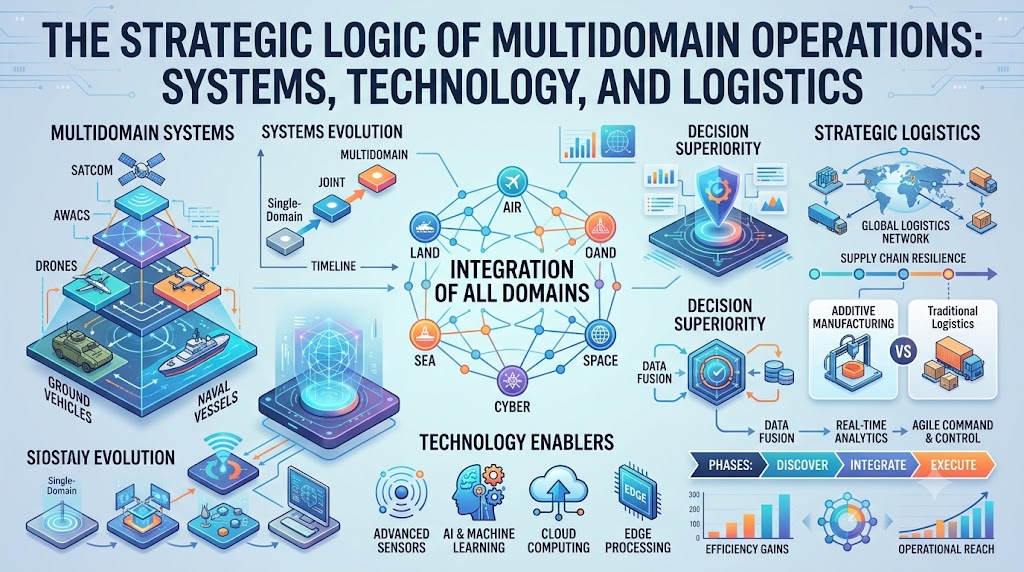
As technological acceleration blurs traditional operational boundaries, defense analysts must move beyond legacy models to understand how modern security entities operate.Multidomain Operations (MDO) provide the conceptual blueprint for this shift. Rather than managing land, sea, air, space, and cyber assets in isolated operational silos, MDO treats these operational arenas as a unified, continuous ecosystem. This approach shifts the strategic focus from merely coordinating separate military branches to synchronizing capabilities across distinct environments at speed.This guide breaks down the structural design of Multidomain Operations, tracing its conceptual roots, decision-making frameworks, technological infrastructure, and operational friction points. Designed for security researchers, policy analysts, and students of strategic history, this article offers an objective framework for studying cross-domain integration. For expanded research modules, historical case studies, and systemic defense analyses, explore the resources available at WarOpsX.
Understanding the Core Concept
Multidomain Operations represent a structural evolution in strategic design, shifting how organizations project influence, gather awareness, and secure objectives across physical and non-physical domains. At its core, MDO addresses a fundamental reality: actions taken in virtual or extra-atmospheric environments directly dictate options on the ground and at sea.
Historically, military branches operated under specialized domain mandates. Navies secured maritime lanes, air forces focused on aerial superiority, and armies maneuvered across ground terrain. While mid-20th-century models introduced "jointness" to foster communication between these entities, MDO demands complete operational integration.
Three primary concepts define this strategy:
- Cross-Domain Layering: Applying capabilities native to one operational arena (such as cyberspace or space) to create favorable conditions or resolve challenges in another (such as land or maritime).
- Synchronized Convergence: Aligning diverse technological, informational, and physical capabilities across time and space to complicate an adversary’s decision-making process.
- Domain Interdependence: Accepting that modern platforms cannot function in isolation; an air or sea vessel relies as heavily on orbital data networks as it does on its physical machinery.
Strategic Objectives and Leadership in Multidomain Settings
Formulating strategy within a multidomain context requires institutional agility and broad perspective. National defense leadership must align procurement, policy guidelines, and force development to support interconnected operations long before forces ever deploy.
Strategic leadership in this setting demands rapid cognitive processing. Decision-makers must continuously interpret complex, multi-layered data streams originating from disparate sources—from orbital sensors to digital network monitors. Planners must also weigh cross-domain trade-offs. For example, deploying a cyber asset to obscure operational preparations may carry distinct diplomatic, legal, or systemic risks compared to traditional physical deterrents.
Resource allocation requires balancing investments between tangible heavy hardware (such as ocean-going vessels or armored units) and intangible assets (such as resilient network architecture, encryption protocols, and data processing systems). Institutional success hinges on creating flexible organizational cultures that adapt as new technologies redefine domain boundaries.
The Evolution from Single-Domain to Multidomain Thinking
The transition toward multidomain integration reflects centuries of institutional adaptation to technological change.
- Segmented Operations: Prior to the 20th century, naval and land forces operated in distinct geographic spheres, constrained by primitive communications and natural geographic barriers.
- Dimensional Expansion: The introduction of aviation during the early 20th century added a vertical dimension to conflict, forcing armies and fleets to integrate anti-air defense and aerial reconnaissance into standard operations.
- Formalized Joint Warfare: In the late 20th century, military doctrine evolved to mandate "joint" staff structures, standardizing procedural cooperation between distinct ground, naval, and air organizations.
- The Networked Era: The rapid expansion of satellite networks and global digital infrastructure during the late 20th and early 21st centuries established space and cyberspace as official, vital operational environments.
Modern MDO framework represents the natural convergence of these historical shifts, recognizing that security challenges manifest across physical, digital, and cognitive planes simultaneously.
Command and Control Systems in Multidomain Operations
Command and Control (C2) systems form the neural network of modern multidomain integration. Effective C2 structures synthesize disparate operational data into a unified, actionable picture for decision-makers.
Key requirements for multidomain C2 architectures include:
- Standardized Protocol Interoperability: Establishing universal technical standards to allow communication systems, radar networks, and database platforms to exchange data without technical friction.
- Dynamic Data Filtering: Structuring information pathways so leaders receive curated, contextualized analysis rather than overwhelming streams of raw data.
- Decentralized Network Resilience: Engineering system nodes so command networks retain functional control even if primary hubs face electronic, physical, or digital disruptions.
While advanced data processing tools accelerate information routing, institutional frameworks preserve clear chains of command to maintain accountability and strategic oversight.
Defense Technology and Technological Integration
Multidomain strategies rely on an interconnected web of hardware systems and digital infrastructure designed to bridge functional gaps between environments.
Advanced Data Analytics and Algorithmic Processing
Data management platforms leverage algorithmic tools to process vast pools of surveillance and environmental data collected across physical and digital domains. These systems aid in predictive modeling, resource allocation, and maintaining structural visibility across complex networks.
Orbital Assets and Autonomous Platforms
Satellite arrays supply indispensable positioning, timing, and global communication links. Concurrently, uncrewed systems across land, sea, and air extend observational range and collect operational data in hazardous environments without endangering personnel.
Systemic Vulnerabilities and Ethical Frameworks
High levels of technological integration introduce unique risks. Networked architectures create digital entry points susceptible to disruption or system degradation. Furthermore, embedding automated analytical systems into defense planning necessitates strong legal frameworks, transparent policy guidelines, and strict human oversight to prevent unintended escalation.
Military Logistics and Sustainment Across Domains
Sustainment within a multidomain model expands far beyond classical transport management. It requires coordinating global supply webs that link physical transport corridors, cloud-based inventory databases, and satellite tracking assets.
Logistical managers navigate several critical friction points:
- Real-Time Inventory Visibility: Utilizing continuous tracking systems to monitor fuel, munitions, replacement parts, and medical supplies across distributed global networks.
- Infrastructure Redundancy: Safeguarding physical transit nodes (ports, rail terminals, air depots) and network infrastructure from physical disruption or digital intrusion.
- Predictive Maintenance Engineering: Applying analytical monitoring tools to identify machinery fatigue before operational failure occurs.
Without a resilient, multi-layered sustainment strategy, cross-domain operational models lose efficacy over extended timeframes.
Intelligence, Surveillance, and Reconnaissance (ISR)
Intelligence, Surveillance, and Reconnaissance (ISR) provides the operational context necessary to direct multidomain assets. The ISR process systematically gathers, processes, and evaluates multi-source inputs to clarify complex environments.
- Multi-Source Data Acquisition: Collecting raw inputs from space-based sensors, aerial imagery, maritime sonar arrays, ground radars, and digital network monitors.
- Synthesis and Verification: Converting disparate data streams into standardized intelligence through rigorous analysis and cross-verification.
- Analytical Decision Support: Delivering contextualized assessments to planners to minimize ambiguity and improve strategic timing.
The fundamental challenge in modern ISR is analytical triage: extracting critical structural patterns from overwhelming volumes of continuous incoming data.
Organizational Structure and Joint Forces
Adapting to a multidomain model requires reforming traditional organizational hierarchies. Legacy force structures organized around single-domain branches can foster institutional competition and communication barriers. Modern approaches construct unified joint force structures designed for integrated management.
Functional Layer
Strategic Focus
Core Administrative Duties
National Strategic Leadership
Long-range policy & national objectives
Resource distribution, institutional policy, high-level guidance
Joint Operational Commands
Cross-domain integration & theater planning
Aligning land, air, sea, space, and cyber components
Domain-Specific Commands
Environment management & force readiness
Training, specialized capability maintenance, platform oversight
Logistics & Network Commands
Infrastructure sustainment & network integrity
Managing supply networks, platform repair, cyber defense, data routing
These integrated structures rely on cross-institutional training, shared operational concepts, and standardized procedures to ensure personnel collaborate effectively regardless of their primary domain background.
Key Dimensions of Multidomain Operations
Operating Environment
Primary Focus
Enabling Technologies
Core Friction / Strategic Constraint
Land Domain
Ground terrain, population centers, transit corridors
Mechanized platforms, ground sensors, tactical radio networks
Complex topography, high logistical consumption
Maritime Domain
Oceanic sea lanes, littorals, choke points
Surface vessels, sub-surface platforms, maritime radar arrays
Vast distances, harsh natural environments
Air Domain
Airspace management, rapid movement, high-altitude surveillance
Fixed-wing aircraft, rotary systems, uncrewed platforms
High fuel requirements, dependence on fixed shore installations
Space Domain
Orbital architecture, global communication, positioning assets
Navigation satellite arrays, sensor suites, ground launch complexes
High cost, orbital decay risks, vulnerability of fixed nodes
Cyber Domain
Digital networks, data infrastructure, software systems
Encryption protocols, cloud infrastructure, firewall architectures
Rapid technological obsolescence, attribution challenges
Historical and Hypothetical Case Studies
Historical Case Study: The Integrated Air Defense Network of the 1940s
During the Battle of Britain, the British military established the "Dowding System," integrating ground-based radar arrays (electromagnetic observation), terrestrial telephone lines (information relay), central tracking rooms (data synthesis), and fighter aircraft (air domain execution). By linking ground sensors to aerial interceptors via centralized data processing, this system demonstrated early principles of cross-domain integration long before digital computing existed.
Historical Case Study: Satellite Integration in the 1990s
The operational integration of the Global Positioning System (GPS) during the Gulf War (1990–1991) highlighted the transformative power of the space domain over terrestrial operations. Ground units navigated featureless desert terrain, naval platforms refined precision transit, and aerial assets synchronized strikes using orbital timing signals. This marked a historical shift where space became an indispensable operational domain for physical forces.
Hypothetical Case Study: Humanitarian Logistics Coordination
Imagine a complex humanitarian relief initiative managed by a multinational coalition following a disaster that rendered coastal infrastructure unusable. Ground routes are washed out (land challenge), ports are blocked (maritime challenge), local power and cell grids are destroyed (cyber/information challenge), and severe atmospheric weather limits visual flight (air challenge).
To coordinate relief, planners employ synthetic aperture radar satellites (space) to map terrain changes through cloud cover, deploy autonomous air platforms (air) to pinpoint stranded populations, establish ad-hoc satellite-linked data networks (cyber) to replace local infrastructure, and deploy shallow-draft hovercraft (maritime) to move emergency aid to inland distribution points (land logistics). This scenario illustrates how cross-domain coordination operates within complex emergency management contexts.
Strategic Analysis Framework
Academic researchers, policy learners, and defense analysts can apply this eight-step structural framework to evaluate multidomain concepts:
- Clarify the Strategic Objective: Outline the overarching policy, institutional, or security goal.
- Map the Organizational Entities: Identify all participating branches, civilian agencies, and international partners.
- Assess Resources and Environmental Constraints: Evaluate material inventory, financial allocations, geography, and legal boundaries.
- Examine Information and C2 Architecture: Analyze how operational data is gathered, processed, secured, and distributed.
- Evaluate Logistics and Sustainment Vulnerabilities: Review supply line resilience, repair capabilities, fuel distribution, and backup routes.
- Analyze Technical Systems and Interoperability: Determine whether software protocols, hardware interfaces, and communication channels are compatible.
- Identify Systemic Risks and Blind Spots: Pinpoint potential single points of failure, digital vulnerabilities, and unintended policy outcomes.
- Synthesize Historical and Regulatory Context: Evaluate the concept against historical precedents, international conventions, and civil-military governance models.
Key Challenges and Systemic Limitations
Translating multidomain theory into operational reality involves overcoming significant friction points:
- Institutional Parochialism: Traditional branch identities and legacy bureaucratic structures can impede full resource and data sharing.
- Analytical Overload: Streaming uninterrupted data from thousands of orbital, digital, and physical sensors can overwhelm processing nodes and create analytical bottlenecks.
- Legacy Technical Incompatibilities: Equipment built under single-domain parameters often lacks the open-architecture software required to interface with modern networks.
- Network Infrastructure Fragility: Interconnected architectures remain vulnerable to localized physical attacks or digital disruptions targeting centralized data centers and relay nodes.
- Educational and Training Demands: Developing leaders capable of managing cross-domain options requires sweeping adjustments to military education programs.
Common Misconceptions
- Misconception: Multidomain Operations are simply traditional Joint Warfare with new buzzwords.
- Correction: Joint warfare focuses on task-sharing between organizational service branches (Army, Navy, Air Force). Multidomain Operations emphasize the continuous technical and operational integration of physical, digital, orbital, and informational environments.
- Misconception: Advanced technology automatically ensures operational integration.
- Correction: Technology acts merely as a tool. Effective integration requires clear command structures, compatible doctrines, thorough training, and sound strategic judgment.
- Misconception: Space and Cyber are strictly non-combat support functions.
- Correction: Space and cyberspace are primary operational environments. Conditions within them directly constrain or enable options across land, sea, and air domains.
- Misconception: Continuous data access eliminates strategic uncertainty.
- Correction: Abundant raw data does not guarantee clarity. Without effective synthesis, high data volumes can generate noise, delay decision-making, and exacerbate confusion.
Educational Value and Academic Research Directions
For students of policy, international relations, and security studies, analyzing Multidomain Operations opens valuable avenues for academic inquiry:
- Civil-Military Governance: Examining how rapid cross-domain data transmission impacts high-level policy oversight and democratic accountability.
- Defense Procurement Adaptation: Investigating how governmental acquisition models must evolve to procure rapidly shifting digital systems alongside long-lifecycle physical platforms.
- International Law and Domain Governance: Analyzing how existing international legal frameworks apply to emerging non-traditional domains like orbital space and cyberspace.
- Supply Chain and Network Redundancy: Studying systemic resilience within complex transport and information networks under degraded conditions.
Investigating these topics builds a nuanced understanding of modern institutional strategy. To explore further educational guides, research frameworks, and comparative defense analyses, visit WarOpsX.
Ethics and Responsible Defense Analysis
Analyzing modern defense structures requires addressing the legal, human, and ethical questions surrounding cross-domain integration:
- Dual-Use Infrastructure Vulnerability: Because civil and defense operations frequently share space-based communication nodes and digital network pipelines, cross-domain conflict risks impacting non-combatant infrastructure.
- Preserving Human Oversight: Ensuring that automated analytical tools and algorithmic decision-support systems remain subject to strict human judgment and ethical accountability.
- Environmental Sustainability in Non-Traditional Domains: Responsible management of orbital space demands adherence to international standards that mitigate space debris and ensure long-term access for civil, scientific, and commercial entities.
Focusing on objective, educational analysis ensures that technological developments are evaluated alongside legal principles, civil oversight, and human ethics.
Practical Takeaways
- Holistic Systemic View: Multidomain Operations evaluate land, maritime, air, space, cyber, and information environments as an interconnected strategic landscape.
- Deep Integration: MDO expands beyond traditional joint coordination to achieve technical, informational, and operational convergence across all domains.
- Information Integrity: C2 networks and ISR infrastructure form the foundational backbone for managing cross-domain situational awareness.
- Logistical Redundancy: Sustainable multi-environment operations depend on resilient, real-time supply chains and flexible support networks.
- Human Accountability: Sophisticated digital tools support analytical processes, but human leadership remains essential for strategic direction and ethical oversight.
- Ongoing Systemic Friction: Technical incompatibility, analytical overload, bureaucratic silos, and network vulnerabilities present continuous challenges for defense planners.
Frequently Asked Questions (FAQs)
1. What defines Multidomain Operations?
Multidomain Operations (MDO) is a strategic defense framework focused on integrating capabilities across land, sea, air, space, cyberspace, and the information environment to solve complex strategic challenges.
2. How does MDO evolve beyond traditional Joint Operations?
While joint operations focus on coordinating separate military branches, MDO focuses on technical and operational integration across physical, orbital, and digital environments simultaneously, breaking down service-specific boundaries.
3. Why is cyberspace central to modern defense strategy?
Cyberspace serves as the primary medium for data transmission, command networks, and information processing. Maintaining digital integrity ensures that forces can coordinate activities across all physical and orbital domains.
4. How does the space domain support physical operations?
Space systems provide vital capabilities including positioning, navigation, timing signals, high-resolution surveillance, and global communications, which underpin terrestrial, naval, and aerial movement.
5. What is the role of Command and Control (C2) in MDO?
Command and Control networks collect, process, and distribute information from diverse environments, giving leaders clear situational awareness and enabling synchronized decision-making across branches.
6. How do digital systems impact modern logistics management?
Digital technologies enable predictive maintenance, real-time cargo tracking, and automated supply management, helping organizations maintain logistical readiness across complex global supply chains.
7. Why is historical analysis useful for studying modern defense concepts?
Studying historical adaptation helps researchers understand how organizations respond to technological shifts, design effective command structures, and avoid recurring operational errors.
8. What are the major barriers to implementing MDO?
Primary friction points include legacy technical incompatibilities, data processing bottlenecks, rigid bureaucratic silos between branches, digital network vulnerabilities, and heavy training requirements.
9. What is the role of algorithmic tools in strategic planning?
Algorithmic processing tools help analyze large datasets from multiple sensors, identifying patterns and assisting human planners with logistics tracking, environmental monitoring, and risk management.
10. Where can scholars find authoritative research on defense studies?
Researchers can access educational materials through university libraries, peer-reviewed strategic studies journals, policy research archives, and educational knowledge platforms dedicated to defense analysis.
Conclusion
Multidomain Operations mark a significant structural evolution in how defense organizations conceptualize and execute strategy. By viewing land, sea, air, space, and digital networks as an interconnected operational environment, modern security analysis emphasizes the deep connections between command systems, technological integration, logistical resilience, and leadership decision-making. While technological integration expands situational awareness and operational timing, it also introduces systemic friction regarding data management, network security, legacy compatibility, and ethical oversight. Navigating these complexities requires a grounded perspective that balances historical lessons, technical realities, and policy frameworks. As defense environments continue to adapt, educational research platforms like WarOpsX provide valuable, objective insights for students, researchers, and policy learners dedicated to understanding modern defense systems.