NoOps Professional Development: Build Cloud Skills, Earn Certifications, and Improve IT Operations
Introduction
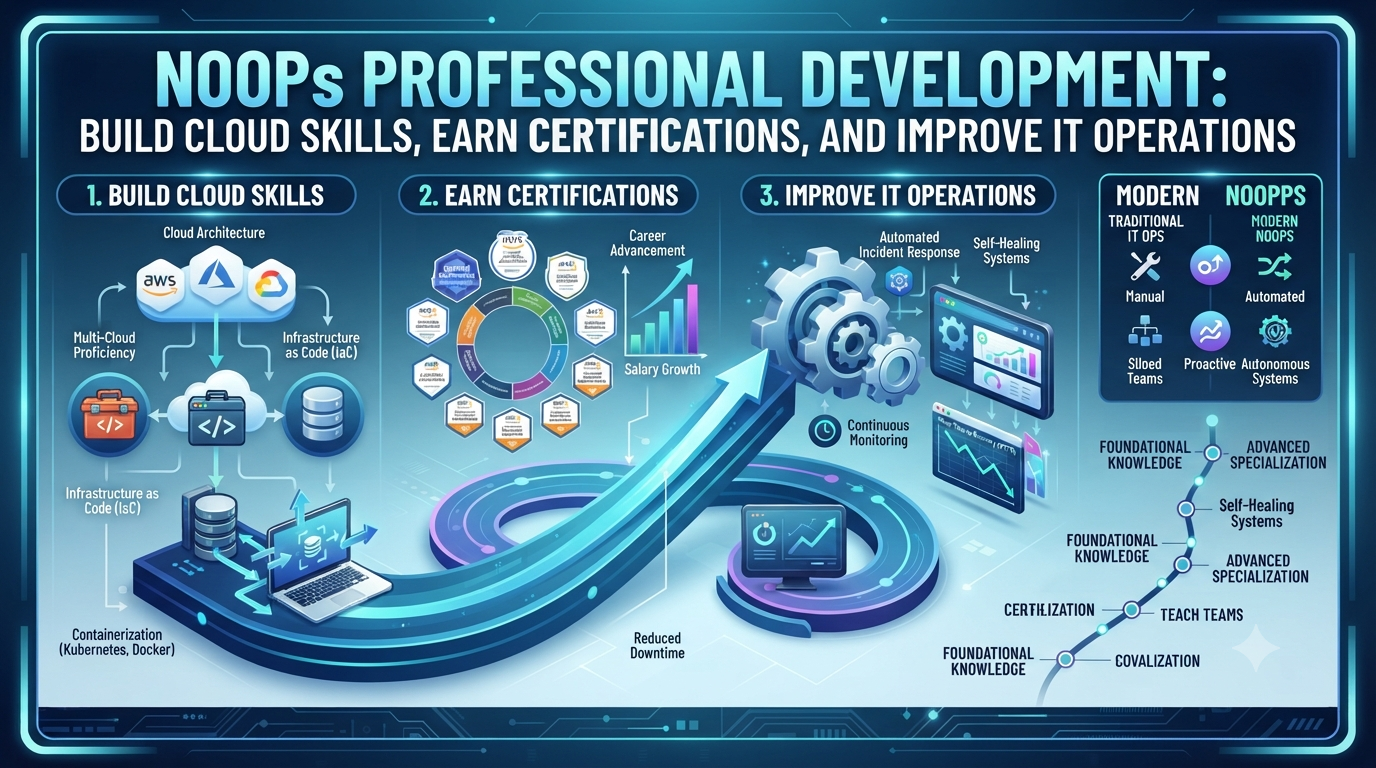
Technology has changed how organizations manage their IT systems. Teams now work with cloud platforms, containers, applications, and digital services. These systems need regular care and careful planning. Repeating the same manual tasks can slow down progress. NoOps offers a way to handle suitable tasks through planned software processes. It helps teams reduce routine work while keeping people responsible for important decisions. Learning what is NoOps can help professionals understand this changing work environment. It can also help organizations review their current operating methods. NoOpsSchool focuses on NoOps education, certification, and consulting. Its advertised learning areas include cloud infrastructure and modern software delivery. This article explores professional skills, learning choices, technical tools, and practical uses of NoOps.
What Is NoOps?
What is NoOps? NoOps is an approach that reduces routine manual work in IT operations. It uses software, scripts, and planned workflows to handle suitable tasks. Examples include preparing infrastructure, applying system settings, and supporting software releases.
NoOps does not remove the need for technical teams. People still plan systems, protect information, and review important changes. They also investigate problems that automated processes cannot safely resolve.
The approach can involve several connected practices:
- Infrastructure as code: Teams describe infrastructure settings in files instead of setting up every resource manually.
- Cloud computing: Organizations use computing services hosted by cloud providers.
- Configuration management: Teams apply consistent settings across systems.
- Continuous integration: Developers regularly combine and check software changes.
- Observability: Teams collect information to understand system activity and health.
- Self-healing processes: Systems take approved steps to address certain known problems.
Understanding what is NoOps means looking beyond tools. Teams need clear rules for each automated task. They must decide which actions can run without approval. They must also know when a person should step in.
Why NoOps Matters for IT Teams and Careers
IT teams support services that customers and employees use daily. They manage applications, databases, cloud resources, and security. As these systems grow, repeated tasks can become difficult to manage.
NoOps practices can help teams organize routine work. They may reduce repeated setup steps and make processes more consistent. This can give professionals more time for planning, testing, and system improvement.
The approach also creates useful learning areas for IT careers:
- Cloud platform fundamentals.
- Scripting and command-line skills.
- Infrastructure planning.
- Container technologies.
- Software delivery workflows.
- Monitoring and troubleshooting.
- Security and access management.
Professionals can build these skills through guided study and practice. They should also understand how different technical systems connect. Learning what is NoOps gives them a starting point for exploring these responsibilities.
However, learning a new approach does not guarantee career progress. Experience, communication, problem-solving, and continued practice also matter.
NoOps vs DevOps: Comparing Their Working Methods
NoOps vs DevOps describes two related ways of managing software and IT work. Both aim to improve delivery and system management. Their focus and working methods are not exactly the same.
DevOps encourages development and operations teams to work together. It supports shared responsibility, regular feedback, testing, and software delivery.
NoOps places more attention on reducing routine operational tasks. It uses suitable software, managed services, and defined workflows. People remain responsible for oversight and complex decisions.
NoOps vs DevOps should not be treated as a choice between good and bad methods. Organizations may use practices from both approaches. Their decision depends on their systems, skills, and business requirements.
For professionals, NoOps vs DevOps can clarify different skill needs. It helps learners compare responsibilities before choosing a training path. Both approaches need reliable systems and skilled people.
NoOps Automation Tools
NoOps automation tools help teams manage repeated technical activities. They can support infrastructure setup, configuration, software delivery, and monitoring.
Different tools serve different purposes:
- Terraform: Describes infrastructure resources through configuration files.
- Ansible: Applies settings and performs repeated tasks across systems.
- Docker: Packages applications with the components they need.
- Kubernetes: Manages applications that run inside containers.
- Jenkins: Supports software build and delivery workflows.
- GitHub Actions: Runs workflows when selected events take place.
- Prometheus: Collects measurements from monitored systems.
- Grafana: Presents system information through dashboards.
Teams should not select tools only because they are popular. They should first identify the problem they need to solve. Then they can compare features, compatibility, security, and maintenance needs.
NoOps automation tools also need regular checks. Outdated settings or poorly tested workflows can create problems. Teams should test changes in a safe environment. They should keep a clear process for reviewing unexpected results.
NoOps Certification: Choosing the Right Learning Program
NoOps certification can help professionals study NoOps concepts in a structured way. It may cover technical subjects, operational practices, and the responsibilities of modern IT teams.
Certification programs can differ in depth and teaching methods. Learners should examine the actual course content before enrolling.
Consider these points when comparing NoOps certification options:
- Course objectives: Check the skills the program aims to teach.
- Technical subjects: Review its cloud and infrastructure topics.
- Practical work: Look for exercises that involve real technical tasks.
- Security learning: Check whether it explains safe system management.
- Assessment: Understand how the program checks learner knowledge.
- Learning support: Review the available study materials and guidance.
A suitable NoOps certification should explain both the value and limits of NoOps. It should not promise guaranteed jobs, promotions, or career results. Learners should choose a program that fits their experience and goals.
NoOpsSchool.com advertises specialized IT education and certification programs. Its listed subjects include cloud-native computing, Kubernetes, Docker, Terraform, and GitOps. Learners can compare these advertised subjects with their learning needs.
NoOps Engineer Certification
NoOps engineer certification focuses on technical knowledge used in modern IT environments. It may cover cloud resources, system configuration, scripting, and monitoring.
Engineers need to understand how infrastructure supports applications. They should also know how software changes affect connected services.
Useful learning subjects may include:
- Cloud resource management.
- Scripting and command-line work.
- Infrastructure configuration through code.
- Container management.
- Deployment workflow basics.
- Monitoring and alert handling.
- Security controls and troubleshooting.
NoOps engineer certification should help learners connect technical ideas with practical work. Engineers can practise reviewing configurations and deployment steps. They should also learn when an automated action needs human approval.
NoOpsSchool.com advertises a learning track for NoOps Engineers. Its advertised subjects include infrastructure as code and cloud-native computing. Learners should check the program outline and compare it with their current skills.
NoOps Architect Training
NoOps architect training focuses on planning and designing IT environments. It helps learners understand how cloud resources, applications, and services work together.
Architects must consider more than technical features. They also review security, reliability, cost, and future maintenance.
A learning path may cover:
- Cloud architecture principles.
- Infrastructure as code.
- Container design and Kubernetes.
- GitOps and software delivery.
- Observability and system monitoring.
- Identity and access management.
- Recovery and resilience planning.
NoOps architect training should explain how to compare different design choices. Learners need to understand why one solution may suit a system better. They should also consider how teams will support that design.
NoOpsSchool.com advertises a learning track for NoOps Architects. Its listed subjects include cloud-native systems and modern software delivery. Professionals can review the advertised topics before selecting a learning path.
NoOps Manager Certification
NoOps manager certification relates to planning and guiding technical teams. Managers need to understand how planned workflows change daily responsibilities.
They should know which tasks can follow approved rules. They must also identify decisions that need human attention.
Possible learning areas include:
- Operational planning.
- Cloud service fundamentals.
- Team roles and responsibilities.
- Technical risk reviews.
- Service performance checks.
- Change management.
- Communication during incidents.
NoOps manager certification should help managers understand ownership and accountability. They need to ask clear questions about system changes. They should also support communication between technical and business teams.
NoOpsSchool.com advertises learning options for NoOps Managers. Managers can review the listed subjects against their work responsibilities. The right learning path depends on their experience and goals.
NoOps Training Course
A NoOps training course can arrange technical learning into clear stages. Beginners may start with basic concepts. Experienced professionals may focus on infrastructure design or delivery workflows.
A structured course may include:
- NoOps principles and responsibilities.
- Cloud computing fundamentals.
- Scripting and command-line skills.
- Infrastructure as code.
- Docker and Kubernetes.
- CI/CD and GitOps.
- Monitoring and observability.
- Security and incident response.
- Practical system exercises.
A NoOps training course should include hands-on activities. Learners need to work with sample configurations and systems. They should also review mistakes and understand their causes.
NoOpsSchool.com advertises online learning programs and practical labs. Its listed subjects include Terraform, Docker, Kubernetes, serverless architecture, and observability. Learners should review the program outline and available support before choosing a course.
NoOps Consulting Services
NoOps consulting services help organizations review their technical operations. A project may examine infrastructure, cloud services, software delivery, and team processes.
A useful review begins with the existing environment. Consultants need to understand the systems and problems before suggesting changes.
Possible service areas include:
- Operational assessments.
- Infrastructure provisioning.
- Cloud-native modernization.
- CI/CD implementation.
- Infrastructure planning.
- AIOps integration.
- Security automation.
NoOps consulting services should match the organization's real requirements. A company should not introduce new tools without a clear purpose. Its existing systems, security rules, budget, and team skills all matter.
NoOpsSchool.com advertises consulting in areas such as operational assessments and cloud modernization. Its advertised areas also include infrastructure provisioning and security automation. Organizations should confirm the exact service scope before starting a project.
How to Hire NoOps Freelancers
Some organizations need specialist support for a specific task. They may choose to hire NoOps freelancers for technical projects or short-term work.
Start by describing the project in clear terms. Explain the systems, required skills, and expected deliverables.
Review these points when assessing candidates:
- Experience with the required cloud platform.
- Knowledge of Terraform or similar tools.
- Practical Kubernetes understanding.
- Monitoring and troubleshooting skills.
- Security and access management knowledge.
- Clear communication and documentation.
- Relevant project experience.
When you hire NoOps freelancers, ask candidates to explain their working methods. A list of familiar tools does not prove practical ability. Discuss how they would approach your actual requirements.
Set access rules before work begins. Define who owns code and documentation. Agree on testing and approval steps as well.
NoOpsSchool.com advertises access to freelancers with skills in Terraform, Kubernetes, cloud platforms, automated monitoring, and self-healing systems. Organizations should confirm current availability and project suitability directly.
Common Mistakes Learners and Teams Should Avoid
- Thinking NoOps removes all human work: People still manage security, decisions, and complex problems.
- Choosing tools before defining needs: Teams should understand the problem before selecting software.
- Ignoring technical foundations: Cloud and scripting knowledge support advanced learning.
- Skipping practical exercises: Hands-on work helps learners understand system behavior.
- Giving workflows broad permissions: Access should follow clear security rules.
- Automating an unclear process: Teams should review the process before changing it.
- Forgetting system monitoring: Automated workflows still need regular checks.
- Expecting instant career progress: Skills develop through practice and experience.
- Leaving technical changes undocumented: Records help teams understand important decisions.
- Hiring without clear requirements: Freelancers need defined tasks and responsibilities.
A Fictional Example: A Digital Library Service
Imagine a fictional organization called PageBridge. It runs an online library for schools and community groups. Its team manages the website, search service, and digital catalogue.
The team finds that preparing test environments takes too many steps. Different settings sometimes cause problems during software checks. The team decides to review its process.
It describes selected infrastructure settings through Terraform. Developers package the search application with Docker. Kubernetes manages the container-based service.
The team also creates a controlled release workflow. Monitoring tools collect information about system activity. Alerts help staff notice unusual behavior.
The team does not allow every alert to trigger an automatic fix. Engineers review unusual failures and security warnings. A manager approves important infrastructure changes.
Staff members also study modern operational practices. They explore NoOpsSchool.com to review advertised training subjects. These include cloud-native computing, infrastructure as code, and professional learning tracks.
This fictional example shows how NoOps practices can support a team. Defined tasks may follow planned workflows. People still review risks and handle unexpected problems.
How NoOpsSchool Can Help
NoOpsSchool is a specialized IT education, certification, and consulting platform. It focuses on NoOps, cloud infrastructure, and modern software delivery.
The platform advertises learning tracks for NoOps Engineers, NoOps Architects, NoOps Managers, and NoOps Professionals. These tracks address different technical and professional learning needs.
Its advertised learning subjects include:
- Infrastructure as code.
- Cloud-native computing.
- Kubernetes and Docker.
- Terraform and GitOps.
- CI/CD practices.
- Serverless architecture.
- Observability.
- AI-powered operations.
NoOpsSchool.com also advertises hands-on labs and practical learning scenarios. Listed subjects include self-healing infrastructure and automated incident response. These practices still require suitable controls and human oversight.
The platform advertises consulting services as well. These include operational assessments, automation strategy, and cloud-native modernization. Other advertised areas include infrastructure provisioning, CI/CD implementation, AIOps integration, and security automation.
It also advertises access to freelancers with selected technical skills. These include Terraform, Kubernetes, cloud platforms, and automated monitoring. Organizations should confirm availability and project suitability directly.
Learners should review program details before making a decision. Organizations should compare advertised services with their technical needs. The best choice depends on current skills, project goals, and existing systems.
Frequently Asked Questions About NoOps Professional Development
1. Does NoOps change the daily work of system administrators?
It can change how system administrators handle repeated tasks. Some activities may move into scripts or planned workflows. People still review system health, access, and unusual problems. Understanding what is NoOps helps administrators see how their responsibilities may change.
2. How can I check whether NoOps certification matches my experience?
Compare the program's entry requirements with your current knowledge. Review its technical subjects and practical activities. NoOps certification should offer suitable learning for your level. A clear syllabus can help you decide whether the program supports your goals.
3. What practical abilities should I develop alongside NoOps engineer certification?
Practise scripting, configuration review, and basic cloud management. Learn how applications use infrastructure resources. NoOps engineer certification may introduce these subjects, but practical work builds deeper understanding. Safe lab exercises can help you learn without affecting live systems.
4. What should architects consider before choosing NoOps architect training?
Architects should identify the design skills they want to improve. These may include cloud planning, infrastructure definitions, and system monitoring. NoOps architect training should match those needs. Review its technical depth and practical content before selecting a program.
5. Can NoOps manager certification help with operational planning?
It may introduce ideas about responsibility, workflow design, and technical risk. Managers can use this knowledge when reviewing team processes. NoOps manager certification does not replace practical leadership experience. Clear communication and accountability remain important parts of the role.
6. What makes a NoOps training course suitable for working professionals?
A suitable program should fit the learner's current knowledge and available study time. Its topics should relate to real technical responsibilities. A NoOps training course should also explain practical tasks clearly. Review the learning format and support before enrolling.
7. How can teams avoid problems when using NoOps automation tools?
Teams should test workflows before using them in important environments. They should review permissions, logs, and failure responses. NoOps automation tools need regular maintenance and clear ownership. People should be able to pause or review actions when something unexpected happens.
8. What should organizations expect from NoOps consulting services?
Organizations should expect a discussion about their current systems and goals. The project scope should explain the work and responsibilities. NoOps consulting services may cover technical assessments or improvement planning. Specific deliverables should be agreed before the project begins.
9. How should a company protect its systems when it hires NoOps freelancers?
Give freelancers only the access needed for their tasks. Use approved accounts and document important changes. When a company chooses to hire NoOps freelancers, it should also agree on code ownership and review procedures. These steps help protect systems and information.
10. Which professionals may explore NoOpsSchool learning tracks?
NoOpsSchool.com advertises learning tracks for engineers, architects, managers, and NoOps professionals. Its listed subjects include cloud-native computing, Kubernetes, Terraform, Docker, and GitOps. Professionals can review the advertised topics and compare them with their technical responsibilities and learning goals.
Final Thoughts
NoOps gives organizations another way to manage routine IT work. It uses planned software processes for suitable operational tasks. However, systems still need skilled people and clear responsibility. Professionals can prepare by learning cloud services, infrastructure design, and monitoring. Organizations should review their needs before changing existing workflows. NoOpsSchool.com advertises education, certification, and consulting across related subjects. Its program details can help learners explore available topics. Practical experience, careful planning, and human oversight remain essential.