NoOps Automation Skills: A Practical Learning Path for Modern IT Professionals
 Introduction
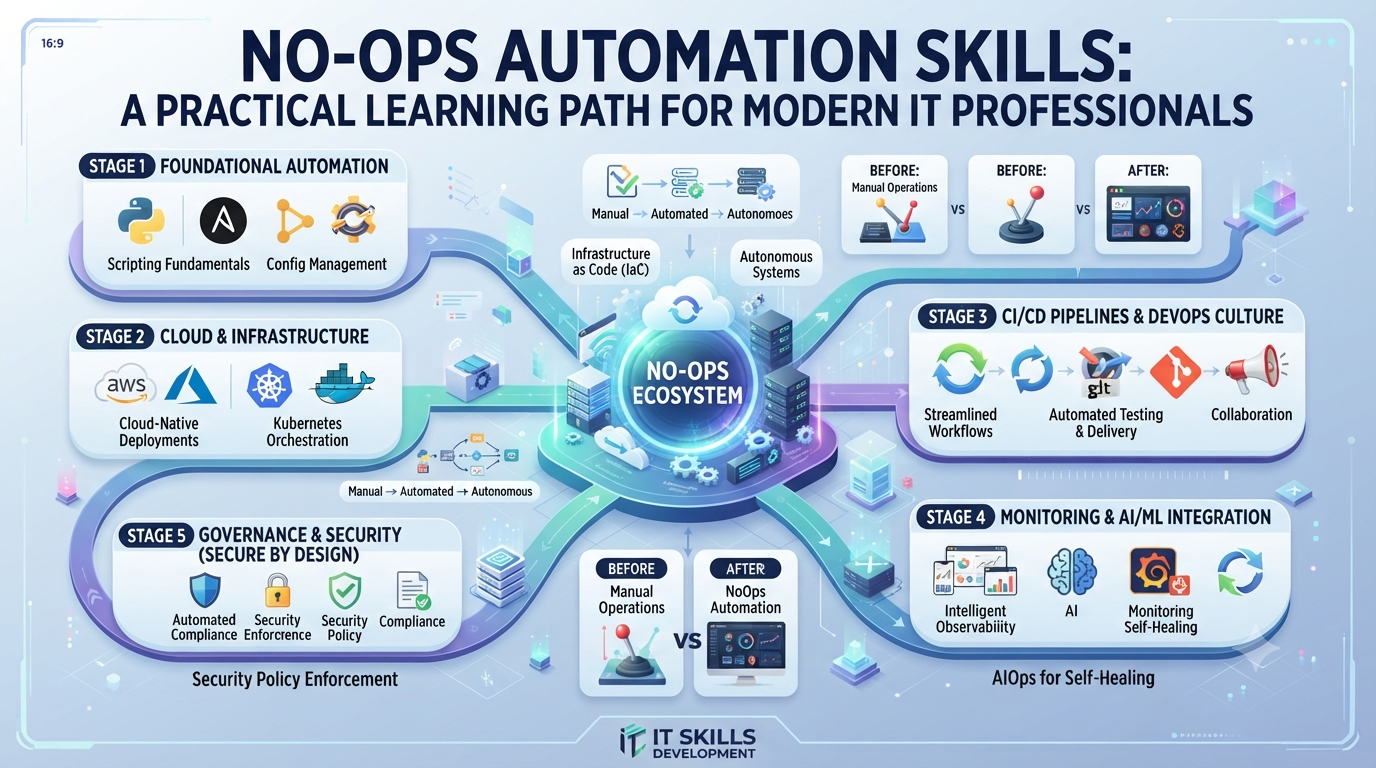
Modern IT systems need to work smoothly without requiring people to handle every small task by hand. Cloud platforms, automated workflows, and smart monitoring systems help teams manage daily technology work with less manual effort. This approach is closely connected to NoOps, which focuses on reducing routine operations through automation. Learning about NoOps can help IT professionals understand how modern infrastructure is built, managed, and improved. A NoOps certification can provide a structured way to study these practices, while a NoOps training course can help learners develop useful technical knowledge. NoOpsSchool focuses on NoOps education, professional learning, and related services. Its learning areas help explain how automation, cloud-native systems, and modern delivery methods fit into today's IT environments.
What Is NoOps?
The term NoOps means No Operations. It describes an approach in which software and infrastructure tasks are automated as much as possible. Instead of depending on people for every routine activity, teams use tools and planned workflows to manage common tasks.
The idea behind NoOps is not to remove people from technology work. It is to reduce repetitive manual activities so skilled professionals can focus on system design, security, reliability, and improvement. Human oversight remains important because automated systems can also make mistakes or face unexpected problems.
A person searching for what is NoOps should understand that it is an operating approach, not a promise that an organisation will never need an operations team. It uses automation to simplify provisioning, deployment, monitoring, and routine maintenance. Learning what is NoOps also means understanding where automation is useful and where human decisions are still needed.
NoOps can involve infrastructure as code, cloud-native platforms, containers, automated testing, and monitoring systems. These technologies allow teams to define repeatable processes and reduce avoidable manual work. A NoOps training course can introduce these ideas step by step, while NoOps certification learning can help professionals organise their knowledge.
Why NoOps Matters for IT Teams and Careers
IT teams often manage many repeated activities. These may include preparing servers, checking system health, applying approved updates, and supporting software releases. When these tasks are performed manually, they can take time and create differences between environments.
NoOps encourages teams to automate suitable tasks through clear rules and reliable tools. This can make processes more consistent and help professionals spend more time on complex work. However, teams still need to review automation, manage access, protect data, and respond to situations that tools cannot handle.
For professionals, learning NoOps can build knowledge across several connected areas:
- Cloud infrastructure: Understanding how cloud resources are created, configured, and managed.
- Infrastructure as code: Learning how infrastructure settings can be written and maintained as code.
- Container technology: Understanding how applications run in containers using tools such as Docker and Kubernetes.
- Delivery automation: Learning how CI/CD pipelines support software building, testing, and release activities.
- Monitoring and observability: Studying how teams collect information about application and infrastructure health.
- Security automation: Understanding how approved security checks and controls can become part of regular workflows.
A NoOps engineer certification may be relevant to professionals who want to study the technical side of automated operations. It can help organise learning around infrastructure, deployment, monitoring, and automation concepts. A NoOps manager certification may suit people who need to understand planning, governance, and team responsibilities.
NoOps knowledge can also support professionals who work with platform engineering, cloud services, or software delivery. The value comes from understanding how systems work together, not simply knowing the names of different tools.
NoOps vs DevOps: Understanding the Main Difference
NoOps vs DevOps is a useful comparison for anyone learning modern IT practices. Both approaches use automation and aim to improve software delivery. However, they place different emphasis on how operational work is organised.
DevOps focuses on collaboration between development and operations teams. It encourages shared responsibility, faster feedback, automation, and continuous improvement across the software delivery process.
NoOps focuses more strongly on automating routine operational activities. It aims to make infrastructure and application operations require less repeated manual work. People still remain responsible for system decisions, security, and unexpected incidents.
Area
DevOps
NoOps
Main focus
Collaboration between development and operations
Reducing routine operations through automation
Team approach
Shared work across development and operations
More automated workflows with human oversight
Automation
Supports development, testing, deployment, and operations
Supports provisioning, deployment, monitoring, and routine operations
Human responsibility
Teams manage and improve delivery processes
People design, review, secure, and improve automated systems
Common learning areas
CI/CD, collaboration, testing, monitoring
Cloud automation, infrastructure as code, self-healing systems
The discussion around NoOps vs DevOps should not become a choice between two competing labels. An organisation may use DevOps practices while also adopting NoOps ideas for suitable tasks. For example, a DevOps team can use automated infrastructure provisioning to reduce repeated setup work.
Understanding NoOps vs DevOps helps learners identify which practices solve different problems. A NoOps training course can explain automation concepts, while NoOps architect training can explore how those practices fit into a wider technical design.
NoOps Automation Tools
NoOps automation tools help teams perform selected technology tasks through scripts, policies, workflows, and platform features. They can reduce repeated manual steps, but they must be configured and checked carefully.
Different tools support different parts of the technology environment:
- Terraform: Helps define and manage infrastructure through code.
- Kubernetes: Helps manage containerised applications across a cluster.
- Docker: Supports building and running applications in containers.
- Git-based tools: Help teams track changes to configuration and application code.
- CI/CD platforms: Automate stages such as building, testing, and releasing software.
- Monitoring platforms: Collect information about system performance and service health.
- Observability tools: Help teams understand system behaviour through metrics, logs, and traces.
- Security automation tools: Support repeatable checks and selected security actions.
Choosing NoOps automation tools depends on the organisation's infrastructure, technical skills, security needs, and existing systems. A tool should solve a clear problem rather than be added only because it is popular.
Professionals studying NoOps automation tools should learn how to configure them, manage permissions, review changes, and handle failures. A NoOps engineer certification learning path can include practical study of infrastructure as code, container platforms, monitoring, and automated delivery.
NoOps automation tools can also support self-healing processes. These processes may detect known problems and apply predefined actions, such as restarting a failed service. They cannot safely solve every issue, so teams need alerts, review procedures, and manual response plans.
NoOps Certification: What Should Learners Look For?
A NoOps certification is a learning and assessment pathway focused on NoOps-related knowledge and skills. Before selecting one, learners should check what subjects it covers and whether the learning activities match their goals.
A useful NoOps certification pathway may include:
- Basic understanding of NoOps principles.
- Cloud infrastructure and resource management.
- Infrastructure as code and configuration practices.
- Container technology and orchestration.
- CI/CD and automated software delivery.
- Monitoring, observability, and incident response.
- Security, access management, and governance.
Learners should also check whether the programme includes practical exercises. Reading about automation is useful, but working through sample configurations and deployment activities can make technical ideas easier to understand.
A NoOps engineer certification should be examined for its technical coverage. Learners can look for topics such as cloud provisioning, scripting, infrastructure automation, container management, and monitoring. The name of a certificate alone does not explain the depth of its learning content.
People comparing NoOps certification options should review the syllabus, learning format, assessment details, and level of prior knowledge expected. They should avoid assuming that a certificate automatically guarantees employment, professional recognition, or a particular career result.
NoOpsSchool.com provides NoOps-focused learning and certification tracks for professionals interested in different responsibilities. Learners can review the available information and decide whether the subjects match their current skills and learning needs.
NoOps Engineer Certification
A NoOps engineer certification focuses on the technical knowledge needed to build and maintain automated infrastructure workflows. It may be useful for IT professionals who work with cloud environments, deployment pipelines, containers, and system monitoring.
A learner exploring NoOps engineer certification topics should understand several practical areas:
- Creating repeatable infrastructure configurations.
- Managing cloud resources through code.
- Working with container images and orchestration.
- Supporting automated software deployment.
- Reviewing monitoring data and system alerts.
- Applying security controls to automated workflows.
The role requires more than running scripts. Engineers must understand what a script changes, which permissions it needs, and what could happen if the process fails. They also need to know when an automated action should stop and request human review.
A NoOps engineer certification pathway can help learners arrange these topics into a planned study process. A NoOps training course can provide supporting explanations and practical learning activities.
NoOpsSchool.com includes learning tracks for NoOps Engineers and other NoOps professionals. Its stated learning areas include cloud-native computing, infrastructure as code, Kubernetes, Docker, Terraform, GitOps, and CI/CD.
NoOps Architect Training
NoOps architect training is intended to develop knowledge of how automated infrastructure and application environments should be designed. An architect considers the full system rather than focusing on one tool or task.
The learning area can include:
- Cloud architecture and resource planning.
- Infrastructure as code standards.
- Container and Kubernetes architecture.
- CI/CD workflow design.
- Security and access-control planning.
- Monitoring and observability design.
- Automated recovery for known failure conditions.
NoOps architect training should also explain the limits of automation. A system may restart a service after a known failure, but it may not understand a new application problem or a complex security event. Architects must plan how people will investigate and manage these situations.
A learner comparing NoOps architect training with a NoOps engineer certification should consider the difference in focus. Engineering learning is often more hands-on with implementation, while architecture learning looks at system structure, design decisions, and long-term management.
NoOpsSchool.com identifies NoOps Architects as one of its professional learning tracks. Its wider learning areas include cloud-native systems, GitOps, platform engineering ideas, and automated infrastructure practices.
NoOps Manager Certification
A NoOps manager certification focuses on the planning and management knowledge needed when teams adopt automation. Managers need to understand technical possibilities as well as operational responsibilities.
A NoOps manager certification learning path may cover:
- Planning automation projects.
- Defining responsibilities across teams.
- Reviewing operational risks.
- Understanding security and governance requirements.
- Measuring whether automation supports team goals.
- Planning training and skill development.
Managers do not need to write every automation script themselves. However, they should understand what the systems are expected to do and how teams will monitor them. They must also ensure that important decisions have clear owners.
A NoOps manager certification can help learners explore the relationship between technical change, team processes, and service responsibility. It should not be treated as proof that a manager can remove all operational risks.
NoOpsSchool.com lists NoOps Managers among its learning tracks. This makes its educational information relevant to professionals who want to study both the technical direction and management side of NoOps.
NoOps Training Course
A NoOps training course gives learners a structured way to study the ideas and technologies used in automated operations. It can be useful for beginners who need an introduction and for experienced professionals who want to organise their existing knowledge.
A well-planned NoOps training course may include the following learning areas:
- NoOps fundamentals and the purpose of automation.
- Cloud computing concepts and infrastructure management.
- Infrastructure as code using tools such as Terraform.
- Containers, Docker, and Kubernetes.
- GitOps and CI/CD workflows.
- Monitoring, observability, and incident handling.
- Security automation and access management.
- Self-healing infrastructure and automated response for known problems.
Learners should check whether the NoOps training course explains each topic with practical examples. They should also review the expected starting level and whether they need prior knowledge of cloud platforms, scripting, or software delivery.
A NoOps training course should help learners understand why a particular automation method is used. Memorising commands without understanding their purpose can make it difficult to manage real systems.
NoOpsSchool.com advertises online learning in NoOps-related areas, including cloud-native computing, infrastructure as code, Kubernetes, Docker, Terraform, GitOps, CI/CD, and observability. Its learning tracks cover NoOps Engineers, Architects, Managers, and Professionals.
NoOps Consulting Services
NoOps consulting services relate to professional support for organisations that want to understand or improve their use of operational automation. The work may involve reviewing current processes, identifying suitable automation opportunities, and planning technical changes.
The site advertises NoOps consulting services in areas such as:
- Operational assessments.
- Automation strategy.
- Cloud-native modernisation.
- Infrastructure provisioning.
- CI/CD implementation.
- AIOps integration.
- Security automation.
Organisations considering NoOps consulting services should first identify the problem they want to address. For example, a team may need a clearer infrastructure provisioning process or a more consistent deployment workflow.
A consulting plan should explain the work involved, expected responsibilities, security requirements, and how progress will be reviewed. Teams should also understand which tasks will remain under human control.
NoOps consulting services do not mean that every operational process can be automated. Some decisions require technical judgement, business approval, or direct investigation. A responsible approach identifies both suitable automation tasks and the situations that need people.
NoOpsSchool.com advertises consulting areas connected to automation strategy and modern cloud operations. Organisations can review the site's stated service information to understand whether its areas of focus relate to their needs.
How to Hire NoOps Freelancers
Organisations may need outside technical support for a specific automation project. The phrase hire NoOps freelancers refers to finding independent professionals who can help with NoOps-related tasks.
The platform offers access to professionals with advertised skills in areas such as Terraform, Kubernetes, cloud platforms, automated monitoring, and self-healing systems. The availability of particular professionals or skills should be checked directly.
Before deciding to hire NoOps freelancers, an organisation should define the work clearly. A project description can include the current infrastructure, required changes, security rules, expected deliverables, and access limits.
A careful selection process may include these steps:
- Write down the technical problem and project scope.
- Identify the tools and platforms involved.
- Review relevant experience and practical work examples.
- Discuss the proposed approach and possible risks.
- Agree on access permissions and security responsibilities.
- Define testing, documentation, and handover requirements.
When businesses hire NoOps freelancers, they should not give broad access without a clear reason. Use appropriate permissions, review code changes, and keep control of important accounts and infrastructure.
A freelancer can help with implementation, but the organisation remains responsible for its systems. Teams should plan who will review the work, maintain the automation, and respond if a workflow stops working.
Table: NoOps Learning and Service Options at a Glance
Option
What It Covers
Who It Helps
NoOps certification
Core NoOps concepts and structured learning
Learners building foundational knowledge
NoOps engineer certification
Infrastructure, cloud, and automation skills
Technical professionals
NoOps architect training
Architecture, design, and automation planning
System and cloud architects
NoOps manager certification
Planning, governance, and team responsibilities
IT managers and team leads
NoOps training course
Guided study of NoOps technologies and practices
Beginners and working professionals
NoOps consulting services
Assessment and automation-related professional support
Organisations
Hire NoOps freelancers
Independent support for selected technical tasks
Teams needing project-based skills
Common Mistakes Learners and Teams Make
- Thinking NoOps means no people: NoOps reduces repeated manual work, but people still manage security, decisions, and unexpected incidents.
- Choosing tools before understanding the problem: Teams should identify the task they want to improve before selecting NoOps automation tools.
- Ignoring security permissions: Automated workflows need carefully controlled access to cloud accounts, code, and infrastructure.
- Learning only commands: A NoOps training course should help learners understand the purpose and impact of each process.
- Expecting automatic recovery for every failure: Self-healing systems are useful for known conditions, not every technical or security problem.
- Confusing different professional roles: NoOps engineer certification, NoOps architect training, and NoOps manager certification have different learning priorities.
- Skipping documentation: Automation should be understandable to the people who need to review, maintain, or change it.
- Assuming certification guarantees a job: A NoOps certification can support learning, but career outcomes depend on many factors, including experience and practical ability.
- Giving freelancers unclear instructions: Organisations that hire NoOps freelancers should define scope, access, deliverables, and review responsibilities.
- Treating NoOps and DevOps as opposites: Understanding NoOps vs DevOps helps teams combine useful practices instead of choosing a label without considering their needs.
A Simple Example: A Fictional Online Ticketing Company
Consider a fictional company called QuickSeat that operates an online ticket booking platform. Its development team regularly needs test environments to check new features. Earlier, team members prepared these environments manually, which involved several repeated configuration steps.
The company decides to study NoOps practices. Its engineers use infrastructure as code to describe the required test environment. They also create a controlled workflow that prepares the environment when an approved request is submitted.
The team introduces monitoring to identify common service problems. For a known issue, a predefined process can attempt a safe recovery action and notify the responsible engineer. If the problem is unfamiliar or affects important data, the system sends an alert for human investigation.
QuickSeat's technical lead reviews NoOps training course material to understand the tools and processes involved. An engineer studies NoOps engineer certification topics, while the platform architect explores NoOps architect training. The manager reviews responsibilities through NoOps manager certification learning areas.
The company also considers NoOps consulting services for parts of its automation planning. If it needs project-based help, it may explore the option to hire NoOps freelancers. It reviews NoOps certification information before choosing a suitable learning path.
This fictional example shows how automation can reduce repeated work without removing people from important technical decisions. NoOps automation tools support the process, while the team remains responsible for reliability and security.
How NoOpsSchool. Can Help
NoOpsSchool.com focuses on NoOps education, certification learning, and related professional services. Its learning areas are intended for NoOps Engineers, NoOps Architects, NoOps Managers, and other NoOps Professionals.
The platform's advertised topics include infrastructure as code, cloud-native computing, Kubernetes, Docker, Terraform, GitOps, CI/CD, serverless, observability, and AI-powered operations. It also describes practical learning around automation scenarios, self-healing infrastructure, automated incident response, and platform engineering ideas.
Learners can review its NoOps training course and certification information to understand which subjects match their goals. Organisations can also review the site's advertised consulting areas and access to independent professionals.
Frequently Asked Questions About NoOps Automation Skills
1. What is NoOps, and why do companies use this approach?
NoOps is an approach that uses automation to reduce routine infrastructure and operations work. Companies may use it to make repeated processes more consistent and manageable. It does not remove the need for skilled people, because teams must still review systems, protect information, and handle problems that automation cannot safely resolve.
2. How can I decide whether a NoOps certification matches my learning goals?
Review the syllabus, practical activities, expected knowledge level, and assessment information before choosing a NoOps certification. Check whether it covers the subjects you want to learn, such as cloud infrastructure, automation, monitoring, or security. A certificate should support your learning plan rather than replace practical experience.
3. What should I study before pursuing a NoOps engineer certification?
Basic knowledge of operating systems, networking, cloud computing, and scripting can help before studying a NoOps engineer certification. You should also become familiar with infrastructure as code and software delivery concepts. If you are new to these subjects, start with the fundamentals and build your skills gradually.
4. Who should consider NoOps architect training?
NoOps architect training may suit cloud architects, infrastructure designers, senior engineers, and professionals who plan technical environments. It focuses on how automation fits into system design, security, scalability, and maintenance. Learners should be interested in making architecture decisions rather than only performing individual operational tasks.
5. What does a NoOps manager certification help a team leader understand?
A NoOps manager certification can help a team leader study automation planning, governance, team responsibilities, and operational risk. Managers need enough technical understanding to ask useful questions and review project plans. They also need to ensure that automated processes have clear owners and suitable human oversight.
6. How do I choose a suitable NoOps training course as a beginner?
Choose a NoOps training course that explains basic ideas before introducing advanced tools. Look for clear lessons on cloud concepts, infrastructure as code, containers, and monitoring. Check the practical exercises and any required background knowledge. A gradual learning path can make complex technical subjects easier to understand.
7. What should businesses check before using NoOps consulting services?
Before selecting NoOps consulting services, businesses should define their current challenges and desired project scope. They should review the proposed technical work, access requirements, security responsibilities, documentation, and handover process. They should also agree on how decisions will be reviewed and which tasks will remain under internal control.
8. How can an organisation safely hire NoOps freelancers for automation work?
When an organisation wants to hire NoOps freelancers, it should define the project tasks and required skills clearly. Review relevant experience, discuss the proposed solution, and limit access to what the work requires. Agree on testing, documentation, ownership of changes, and a proper handover before the project begins.
9. Are NoOps automation tools enough to manage every system problem?
NoOps automation tools can handle repeated tasks and selected known failure conditions. They cannot understand every new issue or make every important decision safely. Teams still need monitoring, alerts, testing, security reviews, and people who can investigate unusual problems. Automation should support responsible operations, not replace them.
10. What NoOps learning areas are described by NoOpsSchool.com?
NoOpsSchool.com describes learning areas for NoOps Engineers, NoOps Architects, NoOps Managers, and NoOps Professionals. Its stated topics include cloud-native computing, infrastructure as code, Kubernetes, Docker, Terraform, GitOps, CI/CD, serverless, and observability. Learners can review the available programme information to identify relevant subjects.
Final Thoughts
NoOps is about making technology operations more automated and less dependent on repeated manual tasks. It still requires people who can design systems, check security, review changes, and manage unexpected situations. Learning through a NoOps training course or exploring a NoOps certification can help professionals understand the methods and tools involved. Different learning paths serve different goals, from technical engineering to architecture and management. NoOpsSchool.com provides information about these learning areas and related professional services. Before choosing a programme or project, review its scope and practical content carefully. A strong understanding of automation, responsibility, and system design is more useful than expecting technology to manage everything without human involvement.