DevOps Configuration Management Skills for Consistent Systems
 Introduction
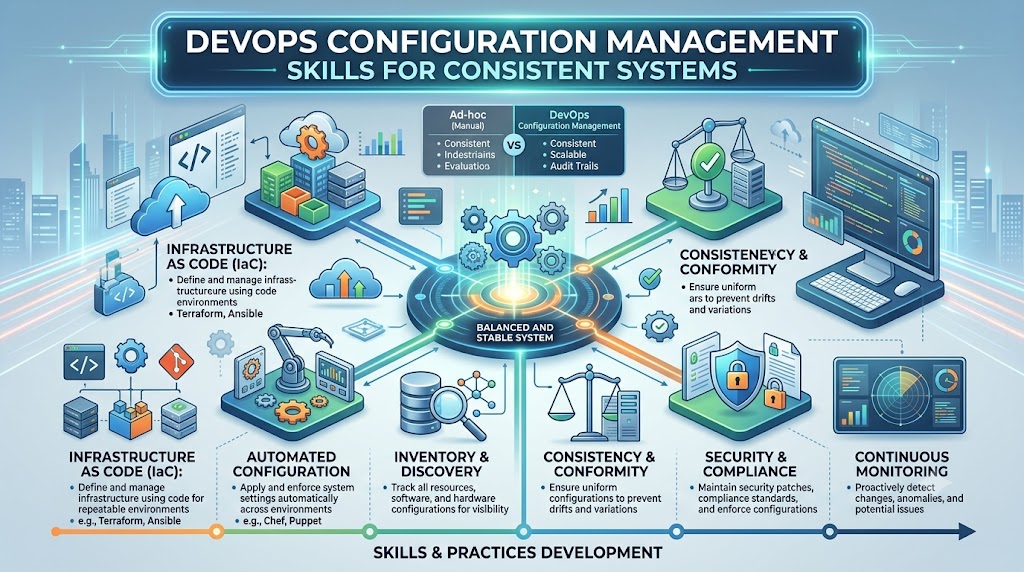
Configuration management keeps system settings organized and consistent. It helps teams manage servers, applications, and environments. Manual changes can create errors and system differences. Configuration management reduces these problems. It fits naturally into a DevOps roadmap. It also supports a clear DevOps learning path. Learners can practice configuration files, automation, templates, and version control. These skills can strengthen a DevOps engineer roadmap.
What Does Configuration Management Mean?
Configuration management means managing system settings in a controlled way. These settings can include packages, users, services, and files. Teams define the desired system state. Automation then applies those settings. This creates more consistent environments. It also makes changes easier to track.
Why This Matters for Your Career
Modern systems can contain many servers. Managing each server manually takes time. It can also create configuration differences. DevOps engineers use automation to reduce this work. Configuration skills support cloud operations and deployment work. They are useful parts of a practical DevOps roadmap.
Building a DevOps Engineer Roadmap
A DevOps engineer roadmap can start with Linux basics. Next, learn configuration files and version control. Then study configuration automation. Practice managing users, packages, services, and files. Create small projects with repeatable configurations. This creates a useful DevOps learning path.
Understanding DevOps Tools
Many DevOps tools support configuration management. Automation platforms can define system states. Git can track configuration changes. YAML files can store readable settings. Cloud tools can manage infrastructure configurations. Choose tools based on the environment and project needs.
DevOps Tools Comparison: How to Choose
A DevOps tools comparison should focus on practical requirements. Check automation support and configuration syntax. Review version control integration. Consider team skills and documentation. Also check cloud compatibility. Avoid selecting tools only because they are popular.
Exploring an SRE Roadmap
An SRE roadmap can include configuration management. Reliable systems need consistent settings. Configuration changes should be controlled and traceable. Automation can also reduce repeated manual work. Learners should practice configuration testing before production changes.
Exploring a Platform Engineering Roadmap
A Platform Engineering roadmap can include standardized configurations. Platform teams often support many development teams. Shared configuration patterns can simplify platform operations. Learners can study templates, automation, access settings, and environment consistency.
Understanding DevOps Certifications
Some DevOps certifications cover configuration and automation concepts. Certification content varies between providers. Learners should check the current exam objectives. Practical projects can add useful experience. Certification study should support hands-on learning.
Following a DevOps Certification Roadmap
A DevOps certification roadmap should match the target career path. Start by identifying the required technical skills. Then select relevant certification topics. Practice configuration tasks while studying. Build small labs around Linux and automation. Review provider requirements before taking an exam.
Finding DevOps Jobs After Learning
DevOps jobs often involve managing repeatable environments. Configuration management can support this work. Create a project with several test servers. Define common settings for each server. Store configurations in version control. Document how changes are applied and tested.
Learning Path Options at a Glance
Learning Track
What It Covers
Who It Helps
Configuration Management
System settings and automation
DevOps learners
Linux Operations
Packages, users, and services
New engineers
Automation
Repeatable system tasks
DevOps engineers
Platform Engineering
Standardized environments
Platform learners
Common Mistakes Learners Make
- Changing production systems manually.
- Keeping configuration files without version control.
- Using unclear configuration names.
- Ignoring configuration testing.
- Mixing environment settings.
- Making automation too complex.
- Skipping documentation.
- Changing many settings at once.
- Reusing unsafe configuration values.
- Failing to review configuration changes.
A Simple Example
Imagine a fictional learner named Riya. Riya manages three test servers. Each server needs the same basic setup. She creates one configuration definition. She stores it in version control. She then applies the configuration to each server. This helps her understand consistent system management.
How DevOpsSchool.org Can Help
DevOpsSchool.org is a free and open software engineering learning platform. It provides structured 90-day learning paths across DevOps and related areas. These include DevOps, SRE, Platform Engineering, GitOps, DevSecOps, FinOps, MLOps, AIOps, CloudOps, DataOps, and SecOps. Learners can explore concepts, tools, labs, projects, tutorials, interview preparation, and certification guidance. The platform also includes a technology directory, global certifications registry, glossary, community resources, SRE roadmap, and Platform Engineering roadmap.
Final Thoughts
Configuration management helps teams keep systems consistent. It reduces repeated manual configuration work. Start with Linux and version control basics. Then learn configuration automation. Practice with small test environments. Keep configuration files organized and reviewed. Test changes before wider use. A practical DevOps roadmap can include these skills. A structured DevOps learning path can make practice easier. Configuration knowledge also supports an SRE roadmap and Platform Engineering roadmap. These skills can strengthen preparation for DevOps jobs and real infrastructure work.